So, what exactly is a customer retention metric? Think of it as a scorecard for your business’s ability to keep customers happy and coming back for more. It’s a key performance indicator (KPI) that tells you, in plain numbers, how many customers stick with you over a given time.
Essentially, these metrics answer a crucial question: are we building lasting relationships, or are our customers walking out the back door as fast as new ones come in?
Why Retention Is Your Most Powerful Growth Engine

While chasing new customers gets all the attention, the real, sustainable growth comes from keeping the ones you’ve already won over. Imagine your business is a bucket you’re trying to fill with water (your customers). If that bucket is riddled with holes (poor retention), you’ll spend all your energy just pouring more water in to keep it from going empty. You’ll never actually fill it up.
This “leaky bucket” problem is exactly why retention is so critical. Every customer you lose is a leak, draining your resources and stalling your growth. Plugging those holes isn’t just about survival; it’s how you build a business that can truly grow and thrive.
The Financial Impact of Keeping Customers
Focusing on customer retention isn’t just a nice idea—it’s one of the smartest, most cost-effective moves you can make. The numbers don’t lie, and they point directly to a healthier bottom line.
A well-known study found that just a 5% boost in customer retention can increase profits by anywhere from 25% to 95%, depending on the industry. Why? Because loyal customers are simply more valuable. Over time, they tend to spend about 67% more than new ones. On top of that, it costs roughly five times more to land a new customer than to keep an existing one happy. You can dig into more of these eye-opening stats on the impact of customer retention on businesses.
Shifting your focus from pure acquisition to a balanced retention strategy isn’t just about saving money. It’s about building a more resilient and profitable foundation for your business.
More Than Just a Number
At the end of the day, a high retention rate means more than just predictable revenue. It’s a strong signal that you have a great product and that your customer experience is hitting the mark. Happy, loyal customers often become your most passionate advocates, driving powerful word-of-mouth marketing that brings in high-quality new leads.
Here’s what a solid focus on retention really gets you:
- Increased Profitability: Loyal customers spend more and cost less to serve. It’s a direct path to better margins.
- Predictable Revenue: A stable customer base makes forecasting easier and creates a more reliable revenue stream.
- Valuable Feedback: Your long-term customers are your best source of honest feedback for improving your products and services.
- Stronger Brand Reputation: Nothing builds a brand better than happy customers spreading the word through positive reviews and referrals.
Your Guide to 6 Essential Retention Metrics

Alright, you get why retention is a big deal. Now for the fun part: measuring it. Think of these metrics as the gauges on your business’s dashboard. Each one tells you something different about the health of your customer relationships, helping you spot trouble before it starts and pounce on opportunities.
We’re going to break down the six most important metrics you need to know. For each one, I’ll give you a straight-up explanation, a simple formula, and a real-world example so you can see how it all clicks together. Let’s put these numbers to work.
1. Customer Retention Rate (CRR)
This is the big one, the classic customer retention metric. The Customer Retention Rate simply tells you what percentage of your customers stuck around over a certain period. It’s your most direct look at loyalty.
Formula: [ (Customers at End - New Customers) / Customers at Start ] x 100
Let’s say you run a SaaS company. You started the quarter with 500 customers. By the end, your count is up to 550, but you know you signed up 100 brand-new customers during that time.
- Customers at End (E) = 550
- New Customers (N) = 100
- Customers at Start (S) = 500
Pop those numbers into the formula: [ (550 - 100) / 500 ] x 100 = 90%. Simple as that. You held on to 90% of the customers you started with. Not bad!
2. Customer Churn Rate
If retention is the hero, churn is the villain. Your Customer Churn Rate is the flip side of CRR, measuring the percentage of customers who bailed on you in a given period. It’s your “leaky bucket” metric—the higher it is, the faster you’re losing business.
Formula: ( Lost Customers / Customers at Start ) x 100
Let’s stick with our SaaS example. You started with 500 customers and ended with 550 after adding 100 new ones. A little back-of-the-napkin math shows you must have lost 50 customers somewhere along the way.
- Lost Customers = 50
- Customers at Start = 500
The calculation is straightforward: ( 50 / 500 ) x 100 = 10%. A 10% churn rate perfectly mirrors your 90% retention rate.
Key Insight: While they’re two sides of the same coin, tracking both retention and churn is a must. Churn feels more urgent and forces you to ask the tough question—why are people leaving? That makes it an incredibly powerful diagnostic tool.
3. Repeat Purchase Rate (RPR)
For anyone in e-commerce or retail, this is your bread and butter. The Repeat Purchase Rate shows what percentage of your customers have come back for more. It’s a dead-simple indicator of whether people actually like your products.
Formula: ( Customers with >1 Purchase / Total Customers ) x 100
Imagine your online shop had 1,000 unique customers last year. Digging into the data, you find that 350 of them made at least a second purchase.
- Customers with >1 Purchase = 350
- Total Customers = 1,000
Your RPR is: ( 350 / 1,000 ) x 100 = 35%. This tells you that over a third of your customers had a good enough first experience to come back for another round.
4. Customer Lifetime Value (CLV)
This one is a game-changer. Customer Lifetime Value (or CLV) estimates the total amount of money you can expect to earn from a single customer over the entire time they’re with you. It pulls the focus away from one-off sales and puts it squarely on the long-term value of your relationships.
Formula: ( Average Purchase Value x Average Purchase Frequency ) x Average Customer Lifespan
Picture a subscription box service.
- The average box costs $50 (Average Purchase Value).
- Customers get one box a month, so 12 times a year (Average Purchase Frequency).
- On average, a subscriber sticks around for 3 years (Average Customer Lifespan).
The CLV is: ( $50 x 12 ) x 3 = $1,800. Once you know a customer is worth $1,800, you can make much smarter calls on how much you’re willing to spend to get them in the door. For teams using platforms like RevOps JET, boosting CLV is the name of the game.
5. Net Revenue Retention (NRR)
SaaS and subscription businesses live and die by this metric. Net Revenue Retention, or NRR, looks only at your existing customers and tells you how much their revenue contribution grew or shrank. It brilliantly accounts for upgrades, downgrades, and churn all in one number.
If your NRR is over 100%, it means you’re making more money from your existing customers than you’re losing from churn. That’s the holy grail—growth without acquiring a single new logo.
Formula: [ (Starting MRR + Expansion - Contraction) / Starting MRR ] x 100
Let’s say you started the month with $100,000 in Monthly Recurring Revenue (MRR).
- You earned an extra $15,000 from customers upgrading their plans (expansion).
- You lost $5,000 from downgrades and another $2,000 from cancellations (a total contraction of $7,000).
Your NRR calculation is: [ ($100,000 + $15,000 - $7,000) / $100,000 ] x 100 = 108%. An NRR of 108% is fantastic. It proves your product is becoming more valuable to your customers over time.
6. Cohort Retention Rate
This is where things get really interesting. Instead of lumping all your customers together, cohort analysis groups them by when they signed up (e.g., the “January 2024 Cohort”). Then, you track how each group’s retention performs over time. It’s an incredibly powerful customer retention metric.
Why bother? Because it lets you see if the changes you’re making are actually working. Did that new onboarding flow you launched in March make the “March Cohort” stick around longer than the “January Cohort”? Now you can know for sure.
Example Scenario: Let’s track your “January Cohort” of 100 new sign-ups.
- Month 1: 90 are still with you (90% retention).
- Month 2: 82 are still active (82% retention).
- Month 3: 75 are still around (75% retention).
By plotting this curve and comparing it to the curves for your February and March cohorts, you can finally connect your actions to their real-world impact on customer loyalty.
To make things even easier, here’s a quick-reference table summarizing the metrics we just covered.
Key Customer Retention Metrics at a Glance
| Metric | What It Measures | Best For |
|---|---|---|
| Customer Retention Rate (CRR) | The percentage of customers kept over a period. | All business models; a high-level health check. |
| Customer Churn Rate | The percentage of customers lost over a period. | All business models, especially SaaS/subscriptions. |
| Repeat Purchase Rate (RPR) | The percentage of customers who buy more than once. | E-commerce, retail, and DTC brands. |
| Customer Lifetime Value (CLV) | The total projected revenue from a single customer. | Businesses focused on long-term relationships. |
| Net Revenue Retention (NRR) | Revenue growth from existing customers (net of churn). | SaaS and subscription-based businesses. |
| Cohort Retention Rate | Retention of specific customer groups over time. | Product and marketing teams measuring impact. |
Each of these metrics tells a different part of the story. The trick is knowing which ones matter most for your business and how to read them together to get the full picture.
Choosing the Right Metrics for Your Business Model
Picking the right customer retention metric is a lot like choosing the right tool for a job. You wouldn’t use a hammer to saw a plank of wood, right? In the same way, you shouldn’t get bogged down tracking metrics that don’t actually tell you how your business makes money. The whole point is to find the numbers that give you the clearest signal for your specific business model.
Let’s be clear: not all retention is created equal. The signs of a healthy, loyal customer base for a subscription software company look completely different from those for an online retail store. Your business model is what sets customer expectations and shapes their behavior, which ultimately defines what “loyalty” even means for you.
Industry benchmarks really drive this point home. For example, media and professional services often see retention rates around a healthy 84%, while e-commerce averages a much lower 38%. This doesn’t mean e-commerce businesses are failing; it just means their path to profitability is built on a different set of customer habits. You can dive deeper into these industry-specific retention rates to get a feel for where you might stand.
For SaaS and Subscription Businesses
If you run a subscription business, your world revolves around recurring revenue. Your goal isn’t just to keep customers around; it’s to grow their value over time. That makes a few key metrics absolutely non-negotiable.
- Net Revenue Retention (NRR) is your North Star. If your NRR is over 100%, it means your existing customers are generating more new revenue (through upgrades and expansions) than you’re losing from churn. It’s the ultimate sign of a healthy, sticky product that people want more of.
- Customer Churn Rate is the classic “leaky bucket” metric. For SaaS companies, a high churn rate can wipe out all your hard-earned acquisition wins, making it a critical health indicator you have to watch like a hawk.
- Customer Lifetime Value (CLV) is what helps you make smart decisions about how much you can spend to acquire a customer (your CAC). When you know what a customer is truly worth over the long haul, you can be confident you aren’t overspending to get them in the door.
For these businesses, a single customer staying for one more month is a clear win. The entire model is built on compounding that loyalty month after month.
For E-commerce and Retail Brands
In the world of e-commerce, the game is completely different. A customer might not buy from you every month, but their decision to come back for a second, third, or fourth purchase is a huge vote of confidence. Here, the focus shifts from the longevity of a subscription to the frequency of transactions.
- Repeat Purchase Rate (RPR) is king. This metric tells you exactly what percentage of your customers liked their first purchase enough to come back for more. It’s one of the purest measures of product-market fit and customer satisfaction you can find.
- Customer Lifetime Value (CLV) is just as vital here. It helps you understand the total value of a customer who might make several purchases over a few years, which justifies investments in things like loyalty programs and retargeting campaigns.
- Purchase Frequency digs a little deeper, telling you how often your average customer actually buys from you. Finding ways to increase this frequency is a direct path to growing revenue from the customers you already have.
For an e-commerce brand, a customer who buys three times a year is incredibly valuable, even if there are months of silence in between. Their loyalty is measured in repeat transactions, not uninterrupted subscription payments.
Matching Metrics to Your Model
So, let’s tie it all together. Just think about the main way your business gets value from a customer and let that guide your focus. Is it through a continuous subscription, or is it through a series of individual purchases?
Here’s a simple way to look at it:
| Business Model | Primary Goal | Key Retention Metrics | Why It Matters |
|---|---|---|---|
| SaaS/Subscription | Maximize recurring revenue | NRR, Churn Rate, CLV | The focus is on long-term engagement and growing accounts over time. |
| E-commerce/Retail | Drive repeat transactions | RPR, CLV, Purchase Frequency | The focus is on encouraging that next purchase and building a buying habit. |
Choosing the right customer retention metric isn’t about picking the most popular one from a blog post. It’s about selecting the one that best reflects the health of the customer relationships that actually drive your business forward. When you align your metrics with your model, you can be sure you’re measuring what truly matters for sustainable growth.
Common Mistakes in Measuring Customer Retention
So you’re tracking customer retention. That’s a fantastic first step, but just having the numbers isn’t the whole story. It’s surprisingly easy to fall into a few common traps that can paint a completely misleading picture, leading you to chase the wrong problems and waste a ton of effort. Getting these calculations wrong isn’t just a data hiccup; it’s a business problem with real financial consequences.
And the stakes are high. Globally, businesses lose an estimated $4.7 trillion every year because of bad customer experiences. To make matters worse, 70% of customers will walk away after just two bad interactions. If you’re misreading your own retention signals, you might be completely blind to the issues pushing your customers out the door. You can discover the latest customer service statistics to dig deeper into this.
Relying on a Single Blended Rate
One of the most common mistakes I see is when a company looks at a single, high-level retention rate and calls it a day. Sure, an overall retention rate of 95% might look great on a dashboard, but that one number can hide a multitude of sins. It’s a blended average that smooths over all the important details.
For instance, your healthy overall rate could be propped up by a large, loyal base of legacy customers. Meanwhile, a brand-new, high-value segment you just acquired could be churning at an alarming 30% a month. Without slicing up your data, you’d never even know there was a fire until the whole building was engulfed.
A blended retention rate is like checking the average temperature of a hospital. It tells you nothing about the individual patients, some of whom might have a dangerously high fever.
You absolutely have to break down your retention data by meaningful segments to get an honest look at what’s going on.
- By Cohort: Are the customers who signed up in May sticking around longer than the ones from January? This is a great way to see if your recent product or onboarding changes are actually working.
- By Plan Type: Are your basic plan users churning more than your enterprise clients? This might point to a problem with how value is perceived at your lower price points.
- By Acquisition Channel: Do customers who came from paid ads behave differently than those from organic search? The answer helps you decide where to put your marketing dollars.
Ignoring Different Types of Churn
Another classic error is treating all churn as if it’s the same. It’s not. The reason a customer leaves matters immensely, and you need to separate them into two main buckets: voluntary and involuntary. They have completely different causes, and therefore, completely different solutions.
Voluntary Churn is exactly what it sounds like—a customer actively chooses to leave. They hit the “cancel subscription” button, stop buying from you, or jump ship to a competitor. This is a direct signal that something is wrong with your product, pricing, or the customer experience.
Involuntary Churn, on the other hand, is when a customer leaves passively. This is almost always due to a failed payment—an expired credit card, not enough funds, or a random network error. The customer never intended to leave; a technical glitch simply pushed them out.
Lumping these two together is a huge mistake because it pollutes your data. If 40% of your churn is actually involuntary, your product isn’t the problem—your dunning and payment recovery process is. By splitting them out, you can point the right teams toward fixing the right problems and get a much cleaner read on how each customer retention metric is performing.
Getting Your Data House in Order: The Foundation of Retention Tracking
Formulas are great, but they’re useless without good data. To really get a handle on any customer retention metric, you need a solid, automated system that pulls clean data from all the right places. For the RevOps and data teams tasked with this, building this foundation is everything. It’s about turning a messy stream of business events into a single source of truth everyone can trust.
The whole point is to map out the entire customer journey. You want to connect the dots from how a customer first found you, to how they actually use your product, and finally, to how they pay you. Without that unified view, you’re just guessing, making decisions based on fragmented data that only tells part of the story.
Identifying Your Core Data Sources
Before you even think about writing code, you have to map your data landscape. Most businesses run on a handful of core tools. When you bring them together, they paint a complete picture of customer behavior. Think of these as the key ingredients for your retention recipe.
Your primary sources will almost always include:
- Customer Relationship Management (CRM): This is your command center for customer interactions. Your CRM (like Salesforce) is where you’ll find account creation dates, customer segments, and all the important sales activities.
- Billing Platform: This is where the money is. Systems like Stripe or Zuora track every subscription, payment, upgrade, downgrade, and cancellation. These are the raw events that power metrics like Net Revenue Retention.
- Product Analytics Tools: Tools like Mixpanel or Amplitude show you what users are actually doing inside your product. They log every click, feature use, and session, giving you the “why” behind your retention and churn numbers.
Stitching these systems together is the bread and butter of any serious RevOps team. For a deeper dive into building robust data infrastructure, the folks at RevOps JET offer some fantastic, engineering-focused insights.
Designing a Simple Data Schema
Once you know where your data lives, the next job is to design a schema—a blueprint for how to organize it. You don’t need a massive, complicated data warehouse right away. Start simple. Just focus on two core concepts: customers and events.
A basic customers table could look something like this:
| Column | Description | Example |
|---|---|---|
customer_id | Unique identifier for each customer | cust_1a2b3c |
signup_date | The date the customer first registered | 2024-01-15 |
plan_type | The subscription plan (e.g., Basic, Pro) | Pro |
mrr | The current Monthly Recurring Revenue | 99.00 |
And your events table would capture what they do:
| Column | Description | Example |
|---|---|---|
event_id | Unique identifier for the event | evt_x7y8z9 |
customer_id | Links the event to a customer | cust_1a2b3c |
event_timestamp | When the event occurred | 2024-03-22 10:05:00 |
event_type | The action taken (e.g., login, upgrade) | login |
With just these two tables, you can join customer details with their actions, which is where the real magic happens.
Getting this part wrong has serious consequences. Bad data leads to flawed analysis, which leads to poor strategic decisions. It’s a domino effect.
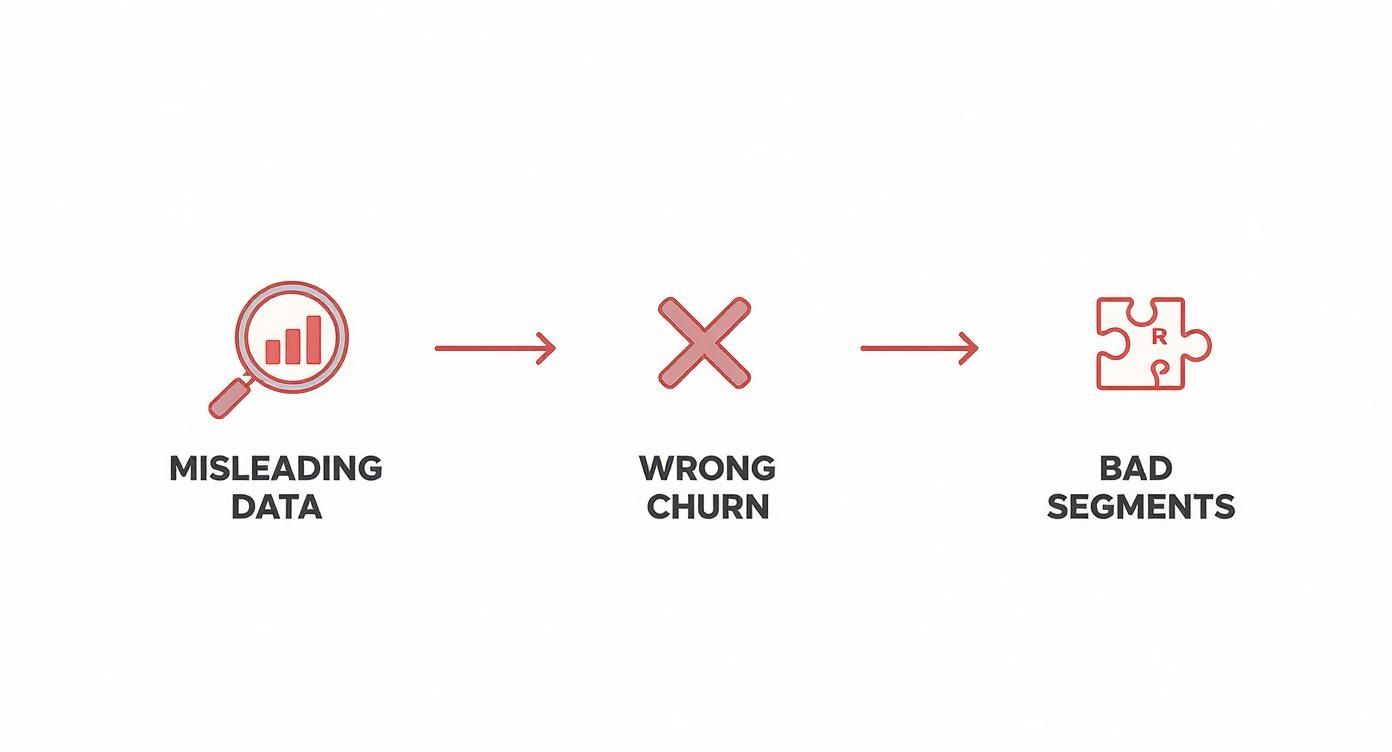
As you can see, a shaky data foundation will inevitably distort your view of customer loyalty and send you chasing the wrong problems.
A Practical SQL Snippet for Cohort Analysis
With your data neatly structured, you can start running more sophisticated calculations, and cohort analysis is a perfect place to start. It helps you see if your product is getting “stickier” over time.
Below is a simplified SQL query that shows how you might group users by their signup month and then track what percentage of them are still active in the following months.
Example SQL Query for Cohort Retention Analysis
This query is a starting point for building a classic cohort retention table. It joins customer signups with their monthly activity, laying the groundwork for a full analysis.
| Code Snippet | Explanation |
|---|---|
WITH user_activity AS ( SELECT c.customer_id, date_trunc(‘month’, c.signup_date) as cohort_month, date_trunc(‘month’, e.event_timestamp) as activity_month FROM customers c JOIN events e ON c.customer_id = e.customer_id GROUP BY 1, 2, 3 ) SELECT cohort_month, — Calculate subsequent months here… FROM user_activity GROUP BY 1; | 1. user_activity CTE: Think of this as a temporary table. It joins your customers and events tables to create a simple log of each user’s activity, month by month.2. date_trunc Function: This is a standard SQL function that cleans up the dates. It rounds them down to the start of the month, making it easy to group users into neat monthly cohorts (e.g., the “January 2024 cohort”).3. Final SELECT: The outer query would then take this organized data and pivot it to show retention percentages for Month 1, Month 2, Month 3, and so on for each cohort. |
This might look technical, but the concept is simple: group users by when they started and watch what they do over time. It’s one of the most powerful views you can have on your business.
The bottom line: Building a retention tracking system isn’t just a data engineering project; it’s about creating a core business asset. A well-built system gives you the clear, unbiased feedback you need to understand your customers and build a product they can’t live without.
Turning Your Retention Metrics into Action
https://www.youtube.com/embed/OvACiui75Ss
Let’s be honest: data is useless if it just sits in a dashboard. Tracking customer retention metrics is a great start, but the real magic happens when you use those numbers to make smarter decisions and drive real change in your business.
It’s all about shifting from being a passive observer of your metrics to an active experimenter. That’s how you turn those numbers into actual growth.
Your Action Plan Checklist
Getting started is easier than you might think. The key is to avoid the temptation to fix everything all at once. Instead, take a methodical, step-by-step approach that builds momentum. This creates a repeatable cycle of continuous improvement.
Here’s a simple framework to turn your insights into a solid strategy:
-
Establish Your Baseline: Before you do anything else, you need to know where you stand. Calculate your key metrics for the last few quarters to get a clear picture of what “normal” looks like for your business. This is your starting line.
-
Set a Realistic Goal: Pick one metric you want to improve. For example, maybe you want to reduce churn by 5% next quarter. A single, focused target keeps the entire team aligned and prevents your efforts from getting diluted.
-
Brainstorm and Prioritize: Now, think about what could actually move that needle. Could you improve your new user onboarding? Maybe launch a loyalty program? What about beefing up your customer support? List out all the ideas and then prioritize them based on which will likely have the biggest impact for the least amount of effort.
The best retention strategies aren’t born from guesswork. They come from targeted experiments designed to solve specific problems you’ve uncovered in your data.
- Launch and Measure: Roll out one initiative at a time and watch your chosen metric like a hawk. By isolating the variable as much as you can, you’ll get a much clearer understanding of what’s actually working and what’s not.
Following this cycle creates a powerful feedback loop. You’ll learn exactly what your customers value, which in turn helps you build a more resilient and profitable business. For more deep dives on putting your data to work, check out the expert insights on the RevOps JET blog.
Got Questions? We’ve Got Answers
Let’s dig into some of the most common questions that pop up when teams start getting serious about tracking retention. These are the practical, real-world issues you’ll likely face.
What’s a Good Customer Retention Rate, Really?
This is the question everyone asks, and the real answer is always a bit unsatisfying: it completely depends on your industry and business model.
A B2B SaaS business with annual contracts would be in trouble with anything less than 90% retention. But an e-commerce store selling seasonal goods? They might be crushing it at 40%. The benchmarks are worlds apart.
Forget about chasing some universal magic number. Instead, focus on your own trajectory. A “good” retention rate is one that’s heading up and to the right. Your real competition is your own performance last month or last quarter.
How Often Should I Be Checking These Metrics?
The right rhythm for measuring retention hinges on how often your customers interact with you.
- High-frequency businesses, like a mobile gaming app or an online grocery store, should probably be looking at this stuff weekly, if not daily. You need to catch a bad trend before it snowballs.
- Subscription businesses, especially B2B SaaS, typically find a monthly or quarterly cadence more useful. It aligns with billing cycles and gives you enough data to see if a change is a real trend or just noise.
The most important thing? Be consistent. Pick a schedule that fits your business and stick to it religiously. That’s the only way you can make fair comparisons over time and know if your efforts are actually working.
Do I Need a PhD in Data Science to Calculate CLV?
Not at all. While you can build incredibly complex predictive models for Customer Lifetime Value, you can get a surprisingly useful estimate with just a few simple inputs.
All you need to start are these three numbers:
- Average Purchase Value: What’s the typical size of a single order?
- Average Purchase Frequency: How many times does a customer buy in a given period (say, a year)?
- Average Customer Lifespan: How long do they stick around as a paying customer?
Just multiply those three together, and you’ve got a solid, back-of-the-napkin CLV. It’s a fantastic starting point for understanding just how valuable a loyal customer is over the long haul.
Ready to build a rock-solid data foundation for your retention analysis? RevOps JET provides on-demand revenue operations engineering to design the schemas, build the pipelines, and write the production-grade code you need. Stop guessing and start engineering your growth.