When people talk about demand generation for SaaS, they often jump straight to tactics like ads and content. But that’s putting the cart before the horse. Real demand generation isn’t about just chasing leads; it’s a long-term play. You’re systematically educating your market so that when a buyer’s need arises, your solution is the only one they can imagine using.
Think of it as the strategic engine that powers predictable growth, connecting every single marketing dollar to a real business outcome.
Getting Your Strategy Lined Up for Real SaaS Growth
A truly high-performance demand gen engine isn’t built on vanity metrics or disconnected campaigns. It’s all about a unified strategy where every action ties directly back to revenue. Before you even think about your tech stack or your next webinar, the real work starts with getting everyone on the same page about your business goals and, most importantly, the exact customers who will get you there.
This means moving past those generic, surface-level buyer personas. We need to define a razor-sharp Ideal Customer Profile (ICP). Your ICP isn’t just a job title and an industry—it’s a detailed portrait of the companies that get the most out of your product and are the most profitable for you to win and keep.
Nailing Down Your Ideal Customer Profile
To build an ICP that actually works, you have to dig into both the numbers and the stories.
-
The Hard Data (Quantitative): Dive into your customer data. Who has the highest lifetime value (LTV)? The lowest churn rate? The shortest sales cycle? Look for common threads in their firmographics—things like company size, industry, location, and even the tech they use.
-
The Ground Truth (Qualitative): Get up from your desk and talk to your sales, customer success, and product teams. Find out which customers they see as the happiest and most successful. What specific, nagging problems did your product solve for them? These conversations give you the color and context that raw data can never provide.
Once you have this mix of data, your profile becomes incredibly specific. You go from a vague “mid-market tech companies” to something like, “Series B to D SaaS companies with 200-1000 employees, using Salesforce and Marketo, who just hired their first Head of RevOps.” That level of detail is what turns good demand gen into great demand gen.
The whole point is to create a profile so crystal clear that anyone on your team can spot a perfect-fit account from a mile away. This clarity stops you from wasting ad spend, creating content for the wrong audience, and sending sales on a wild goose chase.
Slicing Your ICP into Actionable Tiers
Okay, so you have your ICP defined. Now what? The next move is to segment it into tiers. Let’s be honest, not all ideal customers are created equal. Some are worth a much higher investment of your time and resources.
A simple, three-tiered model works wonders here:
-
Tier 1 (The Whales): These are your strategic, high-value accounts that could genuinely change the trajectory of your business. They get the full white-glove treatment with a one-to-one, hyper-personalized Account-Based Marketing (ABM) approach.
-
Tier 2 (High-Priority): This group is full of companies that are a perfect ICP fit but might not be as strategically massive as Tier 1. For them, you can use a one-to-few ABM strategy, personalizing your messaging for small clusters of similar accounts.
-
Tier 3 (Broad Market): This is everyone else who fits your ICP. You’ll engage this tier with a one-to-many approach, using broader content, digital advertising, and SEO to build awareness and generate interest at scale.
This tiered system is all about smart resource allocation. It makes sure you’re focusing your most intensive, expensive efforts where they’ll have the biggest impact. It also directly shapes your entire go-to-market plan and helps you establish clear goals of your CRM, ensuring your data and processes can support these different marketing motions.
Building the Tech Stack That Actually Scales
Alright, you’ve got the strategy nailed down. Now comes the fun part: building the machine to run it. When it comes to demand generation in SaaS, a truly scalable engine isn’t about duct-taping a dozen tools together and hoping for the best. It’s about designing a modern architecture that treats your go-to-market data as the priceless asset it is.
We’re moving away from that tangled mess of brittle, point-to-point integrations that break every time a vendor sneezes. The goal is a clean, hub-and-spoke data model. This isn’t just a nice-to-have anymore; it’s becoming the standard for any SaaS company that’s serious about growth.
The market definitely reflects this shift. The demand generation software space was valued at USD 6.33 billion in 2024 and is on track to hit USD 13.36 billion by 2032. That’s not just random growth; it shows a clear trend of leaders ditching fragmented stacks for unified platforms. If you want to dig into the numbers, you can explore the full demand generation software market analysis here.
Laying a Rock-Solid Data Foundation
The heart of any modern GTM stack is a central data warehouse. Think of tools like Snowflake or Google BigQuery. This warehouse becomes your single source of truth for every piece of customer and prospect data, finally ending those endless debates about which system has the “right” numbers.
But how do you get all that data into the warehouse without losing your mind? The secret is a process called Change Data Capture (CDC).
Forget about those clunky, batch-based API exports from your CRM that run once a day (if you’re lucky). CDC pipelines stream changes from your source systems—like Salesforce—into your data warehouse in near real-time. It’s a game-changer.
- Old-School API Syncs: These are notorious for failing silently, missing records, and choking on large data volumes. The result? Incomplete, outdated data that you can’t trust.
- Modern CDC Pipelines: These capture every single change—every new record, every update, every deletion. You end up with a perfect, auditable mirror of your source data in the warehouse.
This approach guarantees your analytics are always built on the most current and complete dataset possible.
This diagram shows how your GTM strategy—from defining your ICP to aligning teams—acts as the blueprint for the tech stack we’re about to build.
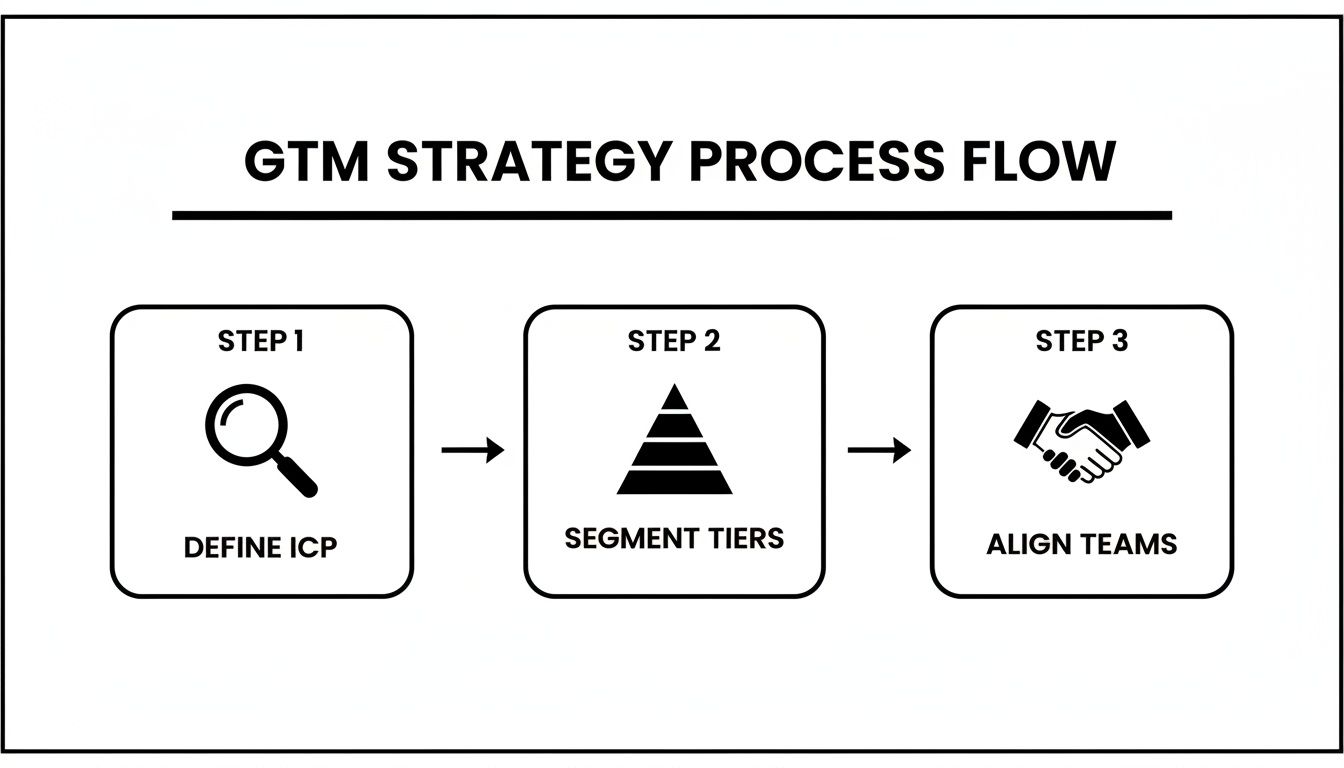
See how it all connects? Your data architecture should directly support the targeted, tiered strategy you’ve already mapped out.
From Raw Data to Real Insights
Just because your data is in the warehouse doesn’t mean it’s useful yet. It’s still in its raw, messy, application-specific format. The next job is to transform and model this data into a clean, logical structure that actually makes sense for your business. This is where a tool like dbt (data build tool) shines.
dbt lets your team write, test, and deploy SQL transformations in a way that’s collaborative and version-controlled (just like software engineering). With dbt, you can build models that do the heavy lifting:
- Clean and Standardize: Fix all the annoying inconsistencies and get data from different sources speaking the same language.
- Join Disparate Sources: This is where the magic happens. Combine CRM data with product usage logs, ad spend from Google Ads, and website behavior from Segment to build a true 360-degree customer view.
- Define Business Logic: Codify your key business metrics—what really constitutes an MQL or SQL, or how you calculate attribution—directly in SQL. Now, everyone is working from the same playbook.
By modeling your data with dbt, you’re creating a pristine set of tables purpose-built for analysis and action. It’s no longer a data dump; it’s a curated, business-ready asset.
Putting Your Data to Work with Reverse ETL
Okay, so you’ve got a warehouse full of clean, enriched, beautifully modeled data. Now what? You have to get it back into the hands of your GTM teams. This is the final, critical piece of the puzzle: Reverse ETL.
This is the process of pushing all that valuable, enriched data out of the warehouse and back into the operational tools your teams live in every day.
Think about what this unlocks. You can sync a perfectly calculated lead score, a real-time product usage metric, or a “most likely to buy” flag directly onto a contact record in Salesforce. This isn’t about looking at another dashboard; it’s about putting intelligence right where your sales and marketing teams can act on it. If you want to go deeper on this, check out our guide that explains what Reverse ETL is and how it works.
This architecture finally closes the loop. Your data warehouse goes from being a passive reporting tool to an active, operational hub that powers your entire demand generation strategy. It’s the difference between looking in the rearview mirror and actively steering the car.
Engineering Scalable CRM and Automation Workflows
Now that clean, enriched data is flowing from your warehouse, the next frontier is the systems where your teams live and breathe—your CRM. It’s time to stop thinking of it as a glorified Rolodex and start treating it like the strategic command center for your entire go-to-market motion. This is the moment a robust demand generation saas strategy truly comes to life.
Too many companies let their CRM architecture become an afterthought. The result is always the same: messy data, confusing page layouts, and brittle workflows that snap the second you try to scale. If you want to build a lasting demand engine, you need to approach your CRM and automation platforms with the same discipline you apply to your core product.
Architecting Your CRM for Go-to-Market Clarity
A well-architected CRM should be a mirror of your business logic, not a generic box you try to cram your process into. For SaaS companies juggling distinct go-to-market motions—like a self-serve product-led growth (PLG) track alongside a high-touch enterprise sales team—custom objects are your secret weapon.
Instead of stuffing every piece of information onto the standard Account or Opportunity objects, think about creating dedicated objects that match how you actually operate:
- Workspace Object: Perfect for a PLG motion. You can track product usage stats, user invites, and feature adoption for a specific instance of your product, completely separate from the sales noise.
- Pilot Object: A must-have for enterprise sales. This lets you manage pre-sale trial periods with clear start/end dates, success criteria, and all the key contacts involved in the evaluation.
This separation keeps your data models clean, which in turn makes reporting a thousand times easier. Your sales team isn’t forced to scroll past irrelevant fields, and your automation has clear, unambiguous data to work with.
The goal is to design a CRM that feels intuitive because it’s built around how your teams actually sell and market. A clean schema isn’t just a technical nicety; it’s a direct driver of GTM efficiency.
Moving Beyond Basic Lead Scoring
Those declarative, point-and-click lead scoring tools are fine when you’re just getting started, but they hit a ceiling—fast. The minute you need to score leads based on complex logic, like aggregating usage data from multiple users at an account or factoring in proprietary data from your warehouse, you have to move to code.
This is where you graduate to writing lead scoring models directly in Apex (for Salesforce) or using a more powerful workflow engine. A code-based model can execute logic that is flat-out impossible with the basic tools.
Thinking about making the switch? Here’s how the two approaches really stack up.
Lead Prioritization Model Comparison
A basic, declarative model gets you in the game, but an engineered model is what helps you win. It’s the difference between a rough guess and a precise, data-backed signal that tells your sales team exactly where to focus their energy.
| Feature | Basic Model (Declarative) | Engineered Model (Code-based) | Business Impact |
|---|---|---|---|
| Data Sources | Limited to standard CRM fields and basic marketing automation data. | Can pull in enriched data from the warehouse, product usage, and APIs. | Highly accurate prioritization, ensuring reps focus on genuinely hot leads. |
| Logic Complexity | Simple additive scoring (e.g., +5 for title, +10 for company size). | Handles complex, weighted logic, time-decay, and account-level aggregation. | Reduces false positives and prevents reps from wasting time on superficially “good” leads. |
| Scalability | Becomes slow and hard to manage as business rules grow. | Built for performance and can handle millions of records and intricate rules. | Maintains speed and reliability as your lead volume and GTM strategy evolve. |
Ultimately, an engineered model gives you a score that truly reflects a prospect’s fit and intent. That’s a massive competitive advantage for your sales team.
Building Production-Grade Automation
Simple, linear workflows are easy to build, but they are an absolute nightmare to maintain. For a demand generation saas engine to be truly resilient, your automation needs to be engineered for the real world—a world where APIs fail, webhooks fire twice, and data arrives out of order.
Using powerful automation platforms like n8n or even custom Python scripts lets you build workflows with production-grade reliability. This means baking in a few critical engineering principles that are too often overlooked in the RevOps world:
- Idempotency in Webhooks: Make sure that if a webhook is accidentally sent twice, it doesn’t create duplicate records or trigger the same action twice. This is non-negotiable for systems that handle lead creation or sales handoffs.
- Proper Error Handling: Your workflow can’t just fail silently. It needs robust try-catch blocks and a clear plan for retries or notifications when something inevitably goes wrong.
- Observability and Monitoring: Log the key steps of your process and push metrics to a monitoring service. You should know when a workflow is running slow or hitting a high error rate before your head of sales does.
Think about a lead routing workflow. Don’t just assign a lead. First, check if the account already has an owner. If not, query your territory management rules. Log the outcome of each step, and if an API call to your CRM fails, queue the lead for a retry in five minutes. This level of detail is what separates amateur automation from a scalable, reliable system you can build a business on.
Running High-Impact and Measurable Campaigns

Okay, you’ve laid the groundwork with a solid strategy and a clean data pipeline. Now for the fun part: turning that potential into actual, measurable pipeline. This is where your demand generation SaaS engine really comes to life, moving beyond random acts of marketing to orchestrate smart, multi-channel campaigns that actually work.
The goal here isn’t to just “spray and pray.” It’s about executing with precision, learning from every interaction, and proving what’s driving growth. Modern demand gen means running integrated plays tailored to your different ICP tiers, all powered by a tight feedback loop between your marketing actions and your data stack.
Orchestrating Targeted ABM and Content Plays
For your top-tier accounts (Tier 1 and 2), Account-Based Marketing (ABM) is your best friend. And I’m not talking about just dropping a company name into an email subject line. This is about creating a truly coordinated, high-touch experience for a hand-picked list of your dream customers.
Think of it like this. A campaign for a Tier 1 account could look like:
- Hyper-Personalized Ads: Running ads on LinkedIn that specifically call out the target company or hit on a pain point you know is relevant to their industry.
- High-Value Content: Sending something tangible, like a custom-printed report or a quality gift, directly to the desks of key decision-makers.
- Coordinated Sales Outreach: The moment a key contact at that account clicks the ad or signs for the package, a sales sequence is automatically triggered in your CRM.
This kind of seamless orchestration is only possible when your data stack is pushing real-time engagement signals back into your sales and marketing tools.
For your Tier 3 audience, the game shifts to broader content plays designed to generate and nurture demand at scale. This is where you create genuinely valuable assets—in-depth guides, webinars, and thought-leadership articles—that attract your ideal customers by helping them solve their problems. The trick is to get this content in front of them where they already are, whether that’s organic search, social media, or niche online communities.
A truly effective campaign doesn’t just happen in one channel. It’s a symphony of touches—an ad that leads to a whitepaper, which triggers a nurture sequence, which is then followed by a timely sales call. Your tech stack is the conductor making sure it all plays in harmony.
Finally Solving the Attribution Puzzle
For years, marketing attribution has been a messy, frustrating puzzle. Most of us have been stuck with simplistic first-touch or last-touch models that barely tell half the story. A modern data stack changes everything.
With all your touchpoint data consolidated in a warehouse like Snowflake, you can finally graduate to sophisticated multi-touch attribution.
This means you can answer the big, important questions with real confidence:
- Which channels are actually best at bringing new target accounts into our world?
- What specific content pieces have the most influence in moving a deal forward?
- What is the true ROI of our ABM program when we factor in every single touchpoint?
The data shows a major disconnect here. While 57% of marketers are planning to spend more on ABM and 73% see content as vital, a massive 41% admit they can’t really measure the results. This is exactly why building a proper data pipeline isn’t a “nice-to-have”—it’s essential. You can dive deeper into the latest demand generation trends and what they mean for your strategy.
Building Metrics Everyone Can Trust
Here’s where it all comes together. The real power move is building your core business metrics directly in a tool like dbt. When your definitions for things like “Marketing Qualified Lead (MQL)” or “Marketing-Sourced Pipeline” are written in version-controlled SQL, they become the undisputed source of truth for the entire company.
No more spreadsheet chaos. No more boardroom debates over whose dashboard is right.
Every report, from the marketing team’s weekly huddle to the board deck, pulls from the same trusted, centrally modeled data. This creates a few huge wins:
- Consistency: Everyone starts speaking the same language and working off the same numbers.
- Transparency: The logic is out in the open. Anyone can see the exact SQL used to define a metric, killing the “black box” problem.
- Agility: Need to change your MQL definition? You update the dbt model once, and every single downstream report and dashboard updates automatically.
When you engineer your metrics this way, you build a culture of data confidence. You finally get to stop arguing about the data and start having strategic conversations about what it means. You can double down on what’s working and prove marketing’s impact with unshakeable clarity.
Keeping Your Engine Healthy with Maintenance and Observability
Building a high-performance demand gen engine is a massive win, no doubt. But the real victory? It’s keeping that complex machine humming along every single day, especially in the relentless world of demand generation saas. This last part is all about two disciplines that are easy to ignore but impossible to succeed without: proactive monitoring and methodical maintenance.
If you don’t have a plan for this, your shiny new data pipelines and automations will start to rust. I’ve seen it happen time and again. It’s not a possibility; it’s a certainty. What you get is a slow, creeping technical debt that eventually boils over into constant fire drills, killing trust in your data and leaving your go-to-market teams frustrated. The only way to keep your engine a reliable asset is to get ahead of the problems.
Setting Up Your GTM Observability
You can’t fix what you can’t see. Observability is all about instrumenting your entire system—from the first data sync all the way to a CRM update—so you have a clear dashboard of its health. It’s the difference between finding out a critical workflow broke from an angry sales director on Slack versus getting an automated alert the second it happens.
And true observability is much deeper than a simple “it worked” or “it failed” notification. You need to be tracking key operational metrics to spot trouble before it snowballs.
- Data Freshness and Volume: Are your data pipelines running on time? Are they pulling in the amount of data you expect? A sudden nosedive in record volume is a classic sign of a broken API connection.
- Model Run Times: Remember that dbt model that used to run in 10 minutes? If it’s suddenly taking an hour, you might have an underlying data quality mess or an inefficient query that needs to be refactored.
- Automation Error Rates: What percentage of your n8n workflow runs are failing? If that error rate starts climbing, it’s a huge red flag that a third-party service probably changed their API without telling you.
Implementing these kinds of checks gives you a real feel for your system’s pulse. To get deeper into this crucial practice, check out our detailed guide on what is data observability.
The Power of a Practical Runbook
When something inevitably breaks, the last thing you want is for only one person on the team to know how to fix it. This is where a runbook becomes your best friend. Think of it as a living document that explains how your systems work and gives clear, step-by-step instructions for troubleshooting the usual suspects.
A great runbook is a force multiplier for your team. It democratizes operational knowledge, reduces dependency on key individuals, and dramatically speeds up incident response times.
Your runbook needs to live somewhere central and easy to find (like a git repository) and should include things like:
- A high-level architecture diagram.
- Contact info for who owns which system.
- Step-by-step guides for common failure scenarios.
Tackling Technical Debt Head-On
The SaaS market is exploding. With forecasts showing that 85% of all business software will be SaaS-powered by 2025 and the market rocketing toward $299.07 billion, the complexity of our work is only going to grow. This reality makes proactive maintenance non-negotiable. It’s telling that 75% of enterprises are now planning to prioritize SaaS backups, which signals a huge shift toward operational maturity. You can discover more insights about SaaS trends on Digital Silk.
In RevOps, technical debt is any brittle, undocumented, or hard-to-maintain process that slows you down. It’s that one gigantic, monstrous workflow that everyone is terrified to touch. Actively managing it means you have to identify these weak points, prioritize them by business impact, and systematically refactor them into clean, tested, and monitored code. It’s a disciplined process, but it saves hundreds of engineering hours down the line and ensures your demand gen engine remains a powerful, reliable driver of growth.
Got Questions? We’ve Got Answers
Stepping up your demand generation game from random acts of marketing to a full-blown, engineered system brings up a ton of questions. It’s totally normal. Below, I’ve broken down some of the most common ones we hear from founders and RevOps pros who are ready to build a growth engine that actually scales.
No fluff here—just straight-up, practical advice on the strategy, measurement, and tech that will make a real difference.
What’s the Real Difference Between Demand Gen and Lead Gen?
This one trips a lot of people up, but the distinction is crucial. It helps to think of it like farming.
Lead generation is the act of harvesting. It’s purely focused on capturing contact info from people who are already raising their hands—filling out a demo form, signing up for a webinar, downloading a guide. It’s a specific, transactional moment.
Demand generation, on the other hand, is the whole farming operation. It’s about cultivating the entire market, tilling the soil, planting seeds, and nurturing them over time. You’re educating people about the problem you solve long before they even know they need a solution. You’re building your brand’s reputation and creating desire.
Simply put, a great demand gen strategy makes lead gen way easier and a whole lot more effective. You’re warming up the entire field, so when it’s time to harvest, you have a bumper crop of high-quality leads who already know and trust you.
How Do You Actually Measure the ROI of a SaaS Demand Gen Program?
If you want to measure the real ROI of your demand generation saas program, you have to look past vanity metrics like clicks and impressions. Even raw lead count can be misleading. The only thing that truly matters is tying every marketing dollar you spend directly to revenue.
A modern data stack is the only way to get this done right.
Here are the metrics that tell the real story:
- Marketing-Sourced Pipeline: How much new sales pipeline came directly from your marketing campaigns? This is your north star.
- Pipeline Velocity: Are deals touched by marketing closing faster than those that aren’t? This proves you’re generating better-educated, more qualified buyers.
- Customer Acquisition Cost (CAC): What’s the total, all-in cost to acquire a new customer through these efforts? No hiding costs here.
- LTV:CAC Ratio: This is the ultimate health check. Is the lifetime value of the customers you’re bringing in significantly higher than what you spent to get them? The goal is a healthy ratio of 3:1 or more.
Getting this level of clarity is impossible with out-of-the-box CRM reports. You need sophisticated multi-touch attribution models built in a data warehouse where you can control the logic and get a true, data-backed picture of your ROI.
Why Bother With Custom Pipelines When Off-the-Shelf Integrations Exist?
I get it. Point-and-click integrations from tools like Zapier or Workato seem like the fast, easy answer. And for simple, non-critical tasks when you’re just starting, they can be fine. But they will absolutely buckle under the weight of a scaling SaaS business. It’s not a matter of if, but when.
These tools create “black boxes.” When something breaks—and it will—you have no visibility into what went wrong or how to fix it. They’re rigid, they can’t handle the unique business logic that makes your company special, and they often choke on the volume of data you need for serious analysis.
This is where engineered data pipelines—using Change Data Capture (CDC), a warehouse like Snowflake, and Reverse ETL—become non-negotiable. They give you three critical advantages:
- Reliability: Built with proper error handling, retries, and monitoring, you always know your data is flowing correctly.
- Scalability: They’re designed from the ground up to handle massive data volumes without even blinking.
- Transparency: You get full control and a clear view of how your data is being transformed and modeled, making sure it perfectly aligns with your business needs.
Yes, a custom pipeline is an upfront engineering investment. But it’s an investment that pays off by preventing the crippling technical debt that kills growth and saves your team hundreds of hours of mind-numbing manual data wrangling down the line.
Stop wrestling with brittle integrations and start building a reliable growth engine. RevOps JET provides on-demand technical revenue operations engineering to design and build the scalable data pipelines and CRM architecture your SaaS company needs. Get your dedicated engineering team for a flat monthly fee.