Thinking about hiring a full-time, six-figure head of revops can feel like a huge gamble. This is especially true if your biggest headache is a hopelessly tangled tech stack, not a leadership void. There’s a much smarter way forward: bringing in a fractional revops remote expert.
This model gets you senior-level engineering talent on-demand to fix what’s actually broken, all without the long-term cost and commitment of a full-time hire. You get production-grade code and scalable infrastructure, not just a bunch of slide decks and high-level advice.
Why Fractional Remote RevOps Is a Strategic Advantage
Let’s be real. Your go-to-market tech stack is probably a patchwork of systems you inherited, held together with quick fixes and duct tape. This kind of technical debt is what slows you down, spits out unreliable data, and burns out your team with endless manual workarounds.
The usual solutions—hiring a full-time leader or signing a massive consulting SOW—are often slow, incredibly expensive, and completely miss the mark. What you really need is hands-on engineering, and that’s where the fractional remote model changes the game. This isn’t about outsourcing your strategy; it’s about insourcing elite engineering talent to solve specific, complex problems right now.
Move Beyond Advice to Production-Grade Code
How many times has a traditional consulting engagement ended with a long list of recommendations but zero actual implementation? It happens all the time. A fractional engineering partner, on the other hand, lives and breathes code. Their deliverable isn’t a strategy document; it’s a functioning, documented, and tested solution committed directly to your Git repository.
Here’s a real-world example: Your Salesforce to Snowflake pipeline is fragile, constantly breaking whenever a schema changes. A consultant might suggest a whole new architecture. A fractional engineer gets in there and builds you a resilient Change Data Capture (CDC) pipeline that automatically adapts to those changes, making sure your data warehouse is always in sync.
The core value of fractional RevOps engineering is simple: you get a senior-level doer who ships production code weekly. It closes that painful gap between strategic intent and technical execution that paralyzes so many growing companies.
Tackle Inherited Technical Debt Head-On
Most RevOps leaders walk into a mess. It could be poorly written Apex code, a labyrinth of untested automations in an iPaaS tool, or a dbt project with zero version control. These issues are a constant drag on productivity and a major risk to the business.
A fractional remote head of revops can systematically chip away at this debt. They can zero in on high-impact projects that actually move the needle, like:
- Refactoring critical code to make it maintainable and properly monitored.
- Building idempotent webhooks that finally put an end to duplicate data entries.
- Creating version-controlled metrics so everyone, from sales to the C-suite, finally trusts the dashboards.
This approach transforms your revenue infrastructure from a liability into a stable, scalable asset. It’s a proactive investment in your company’s future, ensuring your systems can actually support the business as it scales. You can learn more about building this kind of solid foundation by exploring an effective revenue operations team structure that integrates these specialized roles.
Access Niche Skills Without the Full-Time Cost
Let’s be honest, does your team have deep expertise in building custom API integrations with proper error handling and rate limiting? Probably not. And you likely don’t need that skill full-time anyway. But trying to hire for it is both expensive and incredibly time-consuming.
The fractional model gives you access to a bench of specialists on demand. Need to build a complex lead scoring model in Apex or orchestrate a multi-step workflow with Python? You can tap into that specific skill just for the duration of the project. This gives you the technical muscle of a much larger organization without the headcount and overhead. It’s simply the most efficient way to build a revenue engine that truly performs.
Finding and Vetting Your Ideal RevOps Engineer

Before you even think about writing a job description, you need to get real about what you’re actually hiring for. This isn’t a search for a generalist who can “manage” Salesforce. You’re looking for an engineer—someone who can architect, build, and maintain the complex data plumbing your entire go-to-market strategy depends on.
Slapping a generic ad on LinkedIn is a recipe for disaster. You’ll just end up with a flood of point-and-click admins and consultants who talk a big game but have never written a line of code. To find a true remote fractional head of RevOps, you need to craft a profile that speaks their language, prioritizing deep technical skills way above broad strategic experience.
Defining the Non-Negotiable Technical Skills
Your perfect candidate lives and breathes the modern data and CRM stack. They don’t just see a collection of apps; they see a distributed system that needs disciplined engineering practices to run without falling over. Let’s cut through the buzzwords and focus on what actually matters.
Here’s a checklist of absolute must-haves:
- Version Control (Git): Every piece of code they write—whether it’s Apex, Python, or SQL—has to live in Git. This is the absolute baseline for professional software development and is non-negotiable for building systems that won’t give you headaches later.
- Advanced SQL & dbt: They need to be fluent in writing complex, performant SQL and, just as importantly, know how to structure it all inside a dbt project. This is the bedrock of creating trusted, version-controlled business metrics.
- Resilient API Integrations: Ask them for war stories about building integrations that can gracefully handle errors, retries, and rate limiting. Can they explain what idempotency is and why it’s a lifesaver for webhooks?
- CRM Architecture (Salesforce): They need deep experience designing custom objects, writing Apex triggers that scale, and implementing complex logic without constantly hitting governor limits.
The biggest mistake you can make is hiring someone who only knows how to use the UI of a tool. You need a partner who understands the underlying architecture and can build solutions that won’t break when you scale to 10x your current volume.
Where to Find Genuine RevOps Engineering Talent
Top-tier engineers aren’t scrolling through massive job boards. They’re hanging out in niche communities, solving tough problems and sharing what they’ve learned. You have to go where they are.
Forget the usual spots and look in places like:
- The dbt Community Slack: This is ground zero for thousands of analytics engineers talking shop about data transformation best practices.
- Locally Optimistic Slack: Another fantastic, highly respected community packed with data professionals.
- Specialized Marketplaces: Platforms that actually vet for technical skills are goldmines. They can connect you with fractional experts who have a proven track record. Don’t forget about referrals, either—around 20% of fractional work comes from good old-fashioned word-of-mouth.
This targeted approach cuts through all the noise. It puts you in direct contact with candidates who have the specific engineering chops you need. While there are many flavors of a revenue operations manager, you’re hunting for a very specific technical profile.
Interview Questions That Expose True Expertise
Generic interview questions are useless here. You need to design a process that tests for real-world problem-solving and deep technical knowledge. It’s time to move beyond “tell me about a time when…” and get into practical, gritty scenarios.
Try throwing some of these at them:
- “You’ve just inherited a Salesforce org where lead assignment is a mess of a dozen complex Process Builders. What’s your 90-day plan to refactor this into something scalable and maintainable?”
- “Walk me through how you’d build a data sync from a production database to our data warehouse. It needs to capture both deletes and updates in near real-time. What tools are you reaching for, and why?”
- “Our sales team is complaining that their dashboards are slow and the data is all wrong. How would you use dbt to diagnose the root cause and build a set of certified, version-controlled metrics they can finally trust?”
The answers will quickly separate the architects from the playbook-followers. This is absolutely critical. The whole fractional model is surging because companies need this kind of specialized engineering focus. The average fractional RevOps leader earns around $9,651 monthly, but that value is directly tied to their ability to deliver resilient systems, not just generic advice.
Setting Up the Partnership for Success
So you’ve found a fantastic fractional RevOps leader. Great! But the real work starts now. A handshake and a vague scope of work just won’t cut it when you’re dealing with the core infrastructure that drives your revenue. If you want predictable, high-impact results, you need to build the engagement on a rock-solid foundation.
This isn’t about lengthy legal documents or micromanagement. It’s about getting crystal clear on expectations, communication, and what “done” actually looks like. Let’s dig into how to structure this partnership for a win-win.
Get Your Service Level Agreement (SLA) in Writing
Think of the SLA as your operational playbook. It’s not a dusty contract; it’s an active guide that defines the rhythm of your partnership. A good, practical SLA keeps everyone on the same page and should be simple enough for anyone on your team to understand.
Here’s what I always insist on including:
- A Weekly Delivery Rhythm: How often is work being shipped? A weekly cycle is a fantastic starting point. It keeps momentum high and ensures you see tangible progress every single week, rather than waiting months for a big reveal.
- Serious Documentation Standards: This is non-negotiable. Every piece of work, whether it’s a Salesforce Apex trigger or a dbt model for Snowflake, must be fully documented in a shared repository like Git. This creates an audit trail and makes handoffs down the road painless.
- Clear Communication Rules: How will you actually work together? For remote teams, this usually means leaning heavily on asynchronous communication in a dedicated Slack channel. Scheduled meetings should be purposeful, not just “check-ins.”
An SLA isn’t about controlling every move. It’s about creating a predictable, professional cadence. You know what to expect, and your fractional partner has the clear guardrails they need to deliver their best work without constant back-and-forth.
Comparing Fractional RevOps Engagement Models
Not all fractional engagements are built the same. You’ll typically run into two main structures: the classic hourly consulting model and the more modern fixed-fee subscription. Knowing the difference is key to managing your budget and making sure incentives are properly aligned.
Let’s be honest, the traditional hourly model can be a minefield. It seems simple at first, but it can quickly create a conflict of interest. The model rewards logging more hours, not necessarily delivering efficient, elegant solutions. This can lead to projects dragging on and costs spiraling beyond your initial budget. You end up paying for time, not outcomes.
A fixed-fee subscription flips the script. You pay a set monthly fee for access to a dedicated resource and can typically submit unlimited requests into their queue. This model is a game-changer for aligning incentives. The fractional team is motivated to solve problems efficiently to keep their queue moving, and you get predictable costs with a much clearer ROI.
Here’s a quick breakdown to help you compare the two.
Fractional RevOps Engagement Model Comparison
| Feature | Fixed-Fee Subscription (e.g., RevOps JET) | Traditional Hourly Consulting |
|---|---|---|
| Cost Structure | Predictable, fixed monthly fee for a dedicated resource. | Variable, based on hours worked; can be unpredictable. |
| Incentives | Aligned for efficiency and fast, effective problem-solving. | Can incentivize logging more hours rather than delivering results quickly. |
| Request Volume | Typically allows for unlimited requests, managed in a queue. | Capped by budget; every new request incurs additional cost. |
| Budgeting | Simple and easy to forecast for your finance team. | Difficult to budget for, with a risk of scope creep and overages. |
Ultimately, a fixed-fee model puts the focus squarely on results and gives you the cost predictability you need to plan effectively.
Nailing Down Security and System Access
Handing over the keys to your core systems is a big deal. You need a process that gives your fractional partner the access they need to be effective while keeping your data locked down. This requires a bit of forethought, but it’s absolutely critical.
Start with the principle of least privilege. Your head of revops should only have access to the specific tools and data they absolutely need to do their job—nothing more. Use a secure password manager to share credentials, and make sure multi-factor authentication (MFA) is turned on for every single account. No exceptions.
For more complex projects involving data pipelines, a robust strategy is essential. To get a better handle on securely connecting your various systems, it’s worth reviewing these data integration best practices.
Finally, don’t forget about offboarding. What happens when the engagement ends? You need a documented checklist to immediately revoke all system access. It’s a simple step that’s surprisingly easy to overlook, but it’s a non-negotiable part of protecting your company’s most valuable assets.
Hitting the Ground Running: Onboarding Your Remote RevOps Partner
Those first 30 days are everything. A messy, unstructured onboarding can burn through your budget and leave you wondering why you haven’t seen any progress. You’ve hired a technical expert to solve problems, not to get tangled up in HR paperwork or endless intro meetings.
The goal here is simple: get them shipping code and delivering value fast. We’re talking about a structured, remote-first plan that gives them the keys they need to start fixing things, often within the first week. Think a repaired lead scoring model or a brand-new data sync.
Getting Access Right: Secure and Efficient
First things first, let’s get them into your core systems. This needs to be handled with a “trust but verify” mindset, always sticking to the principle of least privilege. They don’t need the keys to the entire kingdom on day one.
Here’s how I usually handle this:
- Your CRM: I always start them in a sandboxed environment. Let them explore your Salesforce or HubSpot architecture without any risk. Once they’re oriented, you can grant controlled production access.
- Your Data Warehouse: Give them read-only access to essential datasets in platforms like Snowflake. This lets them start auditing your data models and understanding the flow of information right away.
- Automation & Integration Tools: They’ll need access to your iPaaS (like n8n or Workato) and any other key middleware to see how the magic happens (or doesn’t).
Use a secure password manager to share credentials, and make multi-factor authentication (MFA) mandatory on every single account. This is non-negotiable. It’s the baseline for protecting your data while empowering your new partner to do their job.
The Technical Discovery: Uncovering the Truth
With access granted, it’s time for a focused technical discovery. This isn’t some fluffy “get to know you” chat. It’s a methodical audit of your entire GTM stack, led by your new head of revops, to map out the current reality—warts and all.
This deep dive should cover a few key areas:
- Auditing the Pipelines: Your partner will trace data from its source all the way to its destination, actively hunting for bottlenecks, manual workarounds, and weak points.
- Spotting the Technical Debt: They’ll dig into custom code, forgotten workflow rules, and brittle automations to find outdated processes that are holding you back.
- Mapping the Architecture: The outcome should be a simple, clear diagram showing how all your systems connect. I’ve found this document becomes an invaluable reference for the entire GTM team.
This initial audit is where a great fractional partner immediately shows their worth. An experienced operator will quickly find the hidden gremlins causing bad data and team frustration. They turn that chaos into a clear, actionable roadmap.
The entire process, from contract to results, needs a solid framework to keep everyone aligned.
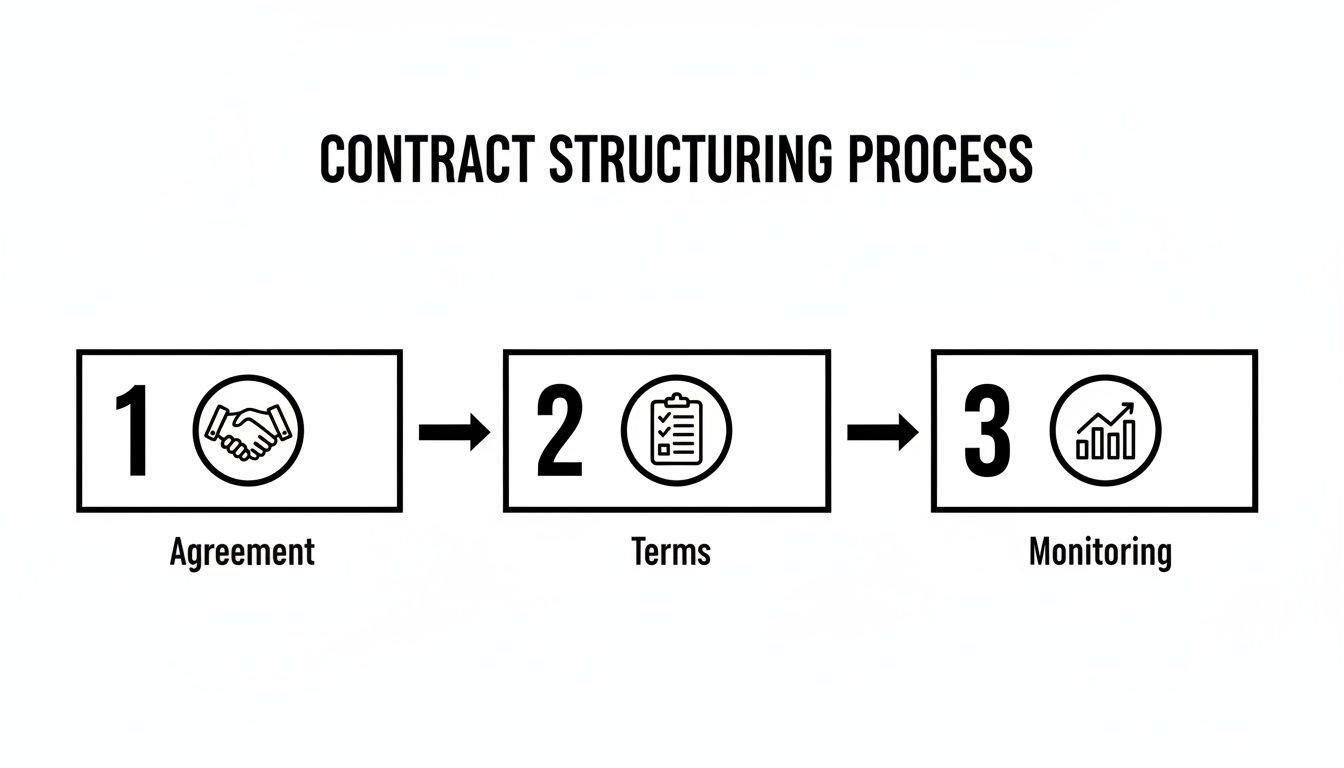
This visual really hammers home the point: a successful partnership is built on a clear agreement, well-defined terms, and—critically—constant monitoring of progress.
Building a Transparent Workflow
For a fractional revops remote partnership to thrive, you need a single source of truth for all work. Forget endless email chains and Slack messages. A shared project board in a tool like Trello, Asana, or Jira is the way to go.
I like to keep the board dead simple:
- Backlog: The prioritized wish list of every project and task we’ve identified.
- In Progress: The one or two things they are actively working on this week.
- Ready for Review: Work that’s done and waiting for your team to test and sign off on.
- Done: Completed tasks, ideally with links to documentation in Git or your knowledge base.
This setup gives you total transparency. You can see exactly what’s being worked on at any moment and adjust priorities on the fly, all without needing to schedule a single status meeting. It’s this kind of structured, asynchronous workflow that lets you hit the ground running and get the most out of your new RevOps partner from day one.
Measuring the Payoff and Building for the Long Haul
So, you’ve brought on a fractional partner. Smart move. But how do you actually prove it was a good investment? The real return isn’t just about the full-time salary you didn’t have to pay. It’s measured in the concrete, operational upgrades that make your entire revenue engine stronger and more reliable.
To really justify the spend, you need to look past the obvious and focus on the technical and process-based wins that create lasting value. This means tracking metrics that show the true health and scalability of your go-to-market infrastructure.
Forget Vanity Metrics—Focus on Real Wins
Counting the number of tickets closed is a waste of time. A top-tier fractional head of revops delivers value that shows up in much more meaningful ways. Your focus should be on tracking improvements that directly impact your team’s efficiency and your data’s integrity.
Here’s where you should be looking for the real impact:
- Fewer Hours Wasted on Manual Engineering: How much time was your internal analytics or engineering team burning on manual data pulls, pipeline fixes, and one-off report building? A successful engagement should hand back hundreds of hours a year to your team.
- More Trust, Fewer Data Fires: Are you seeing a drop in data-related support tickets? If your sales and marketing teams have stopped complaining about broken dashboards, you know your data foundation is finally solid.
- Getting to Insights Faster: How quickly can your analytics team answer critical business questions? With clean, version-controlled dbt models, they should be turning around insights in hours, not weeks.
- Killing Technical Debt for Good: Make a list of all the technical debt that’s been refactored and eliminated. Maybe it was a convoluted lead routing process, a fragile API integration, or an automation nobody was monitoring. Documenting these wins is key.
The most powerful ROI story you can tell is one of reclaimed time and newfound trust. When your teams stop questioning the data and start using it to make smarter decisions, you’ve achieved a true win.
Making the Financial Case for Fractional RevOps
In the world of B2B SaaS, the rise of the fractional revops remote leader has been a game-changer for companies trying to fix technical debt with lean teams. The math just makes sense.
Recent 2025 Fractional Work Statistics show that top fractional pros can earn up to $360,000 annually by managing a few clients at retainers between $5,000 and $10,000 per month. This gives companies access to elite talent without the six-figure salary and benefits package of a full-timer.
This isn’t a fluke; it’s a trend. Post-2023, nearly 70% of fractionals are now charging in that sweet spot. Data from Vendux reveals the average monthly compensation for fractional sales and RevOps leaders hit $9,651 in 2024—a 3.3% jump from the year before, signaling just how hot the demand for remote expertise is.
For a Head of RevOps inheriting a tangled Salesforce to Snowflake pipeline, this model is a lifesaver. A fractional team can easily save a company over 300 engineering hours a year by implementing solutions like weekly, git-documented code pushes.
Always Plan for the Handoff
A great fractional partnership always begins with the end in mind. Whether the engagement lasts six months or two years, you need to be ready for the day you bring the function fully in-house. A smooth transition doesn’t happen by accident; it’s the result of disciplined documentation from day one.
This is exactly why you have to insist on using Git as a non-negotiable. When every piece of code, every dbt model, and every workflow configuration is version-controlled, you’re creating a living, breathing history of your revenue infrastructure.
Your future internal team will thank you when they find these assets waiting for them:
- A Complete Code Repository: All custom code (Apex, Python) and SQL transformations (dbt models) should be neatly organized and accessible in Git.
- Clear, Usable Runbooks: For every critical process, there needs to be a simple, step-by-step runbook explaining how it works, what it depends on, and how to fix it when it breaks.
- Up-to-Date Architectural Diagrams: A clean set of diagrams that visually map out your GTM tech stack and how data flows between systems is essential.
This kind of forward-thinking is what separates a decent engagement from a fantastic one. You aren’t just paying for temporary fixes; you’re investing in a stable, well-documented foundation that your future team can confidently build on. That’s how you ensure the value created by your fractional partner lasts long after their contract ends, giving you a huge head start as you continue to scale.
Got Questions About Fractional RevOps Leaders? You’re Not Alone.
Taking the leap with a fractional, remote Head of RevOps is a major strategic decision, so it’s totally normal to have a few questions. I get it. Leaders I talk to are usually curious about the cost, what the day-to-day actually looks like, and, of course, how to handle data security.
Let’s unpack the most common questions I hear from founders, COOs, and ops leaders who are thinking about this flexible, high-impact model.
How Much Does a Fractional RevOps Leader Actually Cost?
This is almost always the first question, and the answer really comes down to the engagement model you choose.
The old-school way is hourly consulting, which can feel a bit like a blank check. Rates typically land somewhere between $200-$350 per hour. While that might seem simple, the costs can balloon quickly when a project’s scope inevitably expands.
A much more predictable and modern approach is a fixed-fee subscription. You pay one flat monthly fee and get a dedicated engineering resource. This model is great because it aligns everyone’s goals—the provider is motivated to work efficiently and ship high-quality solutions to keep their queue moving. For you, it means no surprise invoices. Your finance team can budget with absolute confidence, which is a massive win.
The real value isn’t just in what you save compared to a full-time hire. It’s about paying for outcomes, not just hours. A fixed-fee model laser-focuses the engagement on shipping production-grade code and solving your real-world business problems, week in and week out.
What Does the Day-to-Day Engagement Look Like?
A great partnership with a fractional RevOps pro thrives on clear, structured communication—and that doesn’t mean more meetings. In fact, it’s the opposite. The best setups run on a smooth, asynchronous workflow managed through a shared project board and a dedicated Slack channel.
Here’s a snapshot of a typical weekly rhythm:
- You add requests: Your team drops tasks into a prioritized backlog on a board like Trello or Asana.
- They start the sprint: Your fractional partner grabs the top-priority item and pulls it into their current sprint.
- They share progress: You get updates directly in Slack and on the project board. No need to chase anyone down.
- They deliver the work: By the end of the week, the completed work is delivered and fully documented in Git.
This cadence keeps things moving forward at a steady clip and gives you complete transparency into what’s being worked on at all times. It empowers your fractional head of revops to do deep, focused work while you stay completely in the loop.
How Do We Keep Our Data Secure with a Remote Partner?
Handing over the keys to your core systems is a big deal. It requires a relationship built on trust and backed by airtight security protocols. This part is completely non-negotiable.
Your security checklist should, at a bare minimum, cover these fundamentals:
- The Principle of Least Privilege: This is rule number one. Grant access only to the specific systems and data needed to do the job—nothing more. Always start them in a sandbox environment before ever touching production.
- Mandatory Multi-Factor Authentication (MFA): Every single account, from your CRM to your data warehouse, must have MFA enabled. There are absolutely no exceptions here.
- Secure Credential Management: Use a professional password manager for sharing all credentials. Never, ever send passwords over email or Slack.
- A Clear Offboarding Process: Don’t wait until the end to figure this out. Have a documented checklist ready to go, so you can instantly revoke all system access the moment an engagement ends.
These are simple but critical steps. They ensure your partner has what they need to be effective while your company’s data stays locked down.
How Does a Fractional Leader Actually Integrate with Our Team?
Seamless integration is all about setting clear expectations and communication norms right from the start. Think of your fractional partner not as an outside consultant, but as an extension of your own operations team.
They should be in the relevant Slack channels where your go-to-market teams are having conversations. While they won’t be in every single meeting, you should absolutely invite them to key strategic sessions where their technical perspective can add a ton of value.
The most critical point of integration, though, is that shared project board. This becomes the central nervous system for your collaboration. It’s where your internal team members can ask questions, provide feedback on work in progress, and see what’s coming up next. This kind of transparent, asynchronous workflow ensures everyone is on the same page without blowing up your team’s existing routines. It’s a model built for impact, not interruption.
At RevOps JET, we provide the dedicated RevOps engineering you need to build a scalable revenue engine without the six-figure hiring costs. For a fixed monthly fee, our team delivers production-grade code, reliable data pipelines, and a rock-solid CRM architecture, all documented in Git. Learn more about how we can help you save hundreds of engineering hours and eliminate technical debt for good.