Tackling technical debt is all about making smart, consistent improvements to your systems before small cracks turn into massive craters. It’s a deliberate balancing act between moving fast today and building a stable foundation that won’t crumble tomorrow.
The goal? Keep your tech stack a powerful asset, not a frustrating liability.
The Real Cost of Clunky RevOps and Data Systems

Before we jump into the “how,” let’s get real about the “why.” Technical debt is so much more than just messy code or a few outdated workflows. It’s a silent killer of growth, quietly siphoning time and energy from your RevOps and Data teams.
This hidden friction pops up everywhere, often disguised as other problems. We’ve all seen it. It’s the convoluted CRM workflow that forces five extra clicks for a simple task, slowing a sales rep down to a crawl. It’s that fragile, undocumented data pipeline that snaps without warning, spitting out reports that make the C-suite question every number they see.
The Ripple Effect on Your Teams
This isn’t just a minor annoyance; it’s a productivity black hole. When a tangled dbt project forces your best analyst to spend half their week deciphering dependencies instead of finding insights, you’re literally paying for wasted time. Every workaround, manual data patch, and emergency fire drill pulls your sharpest minds away from the work that actually moves the needle.
This constant firefighting has very real consequences for the business:
- Missed Revenue: A lead routing rule that’s off by a hair can send a hot prospect into a black hole.
- Flawed Forecasting: When your data is unreliable, so is your ability to plan for the next quarter.
- Team Burnout: Nothing crushes morale faster than forcing talented people to fight with broken tools all day.
Technical debt transforms your tech stack from a powerful engine for growth into an anchor holding you back. It quietly eats away at your team’s capacity and your company’s ability to innovate.
A Critical Business Risk
Ultimately, we have to stop thinking about technical debt as a tech problem and start treating it as a critical business risk. It’s an invisible tax on every single thing you do, and the costs are staggering. Industry studies consistently show that companies are spending a whopping 30–40% of their IT budgets just maintaining legacy systems and fixing past shortcuts. That’s money that could be going toward innovation.
This constant drain makes it impossible to get ahead. Issues like poor data integrity or pipeline failures are just symptoms of a much deeper problem. Getting a handle on your data’s health is the first step, which is why concepts like data observability are becoming essential for modern RevOps teams.
Without that visibility, you’re flying blind, totally unaware of the cracks forming in your foundation. Ignoring this debt isn’t just kicking a can down the road—it’s rolling a snowball down a hill, and it’s picking up speed fast.
How to Find and Measure Your Hidden Technical Debt
You can’t fix what you can’t see. Technical debt usually feels like this vague, creeping dread that something is about to break. To actually get a handle on it, you have to drag it out into the open. That means doing a full-blown ‘debt audit’ across your entire RevOps and analytics stack—turning all those team frustrations into a data-backed case for change.
The whole process starts with a focused hunt for the usual suspects. Think of it like a diagnostic check-up for your systems, looking for the classic symptoms of neglect or a “just ship it” implementation. Each part of your stack has its own favorite hiding spots.
Where to Look in Your CRM
Your CRM is often ground zero for technical debt, especially in companies that have scaled quickly. What looks like a small, harmless issue here can have massive downstream consequences for sales productivity and data integrity.
Start your audit here:
- Obsolete Fields and Objects: Go on a hunt for fields that are no longer used but still clutter up your page layouts. A huge red flag is any field that isn’t brand new but has over 95% null values.
- Overly Complex Automation: Pop the hood on your workflow rules, Process Builders, and Flows. Do you have multiple rules firing on the same object that could be consolidated into one? Look for that spaghetti-like logic that even the person who built it can’t decipher anymore.
- Profile and Permission Set Bloat: Take a hard look at your user permissions. It’s incredibly common to find users with way more access than they actually need, which creates both security risks and a ton of operational confusion.
Uncovering Debt in Data Pipelines and Integrations
Fragile connections and undocumented logic in your data pipelines are the silent killers of trust. The moment a pipeline breaks, it instantly erodes confidence in every single report and dashboard it feeds. Your audit here needs to be all about stability and transparency.
A great starting point is to check out our guide on data pipeline monitoring tools. It’ll give you a good sense of what best-in-class visibility actually looks like.
With that benchmark in mind, check for these common debt indicators:
- Brittle Connections: Are your pipelines constantly failing because of minor API changes from a source system? That’s a classic sign of a poor design that’s missing basic things like retry logic or proper error handling.
- “Black Box” Transformations: Pinpoint any data transformations happening inside the pipeline tool itself where there’s no version control or documentation. This is a massive risk. Logic can be changed or completely lost without a trace.
- Lack of Observability: If you can’t easily see the status, volume, and freshness of your data syncs at a glance, you have significant infrastructure debt. Plain and simple.
Auditing Your dbt Project
Even a beautifully structured dbt project can start accumulating debt as your team grows and priorities inevitably shift. The goal here is to find the spots where complexity has completely outrun clarity.
Keep an eye out for signs like these:
- Tangled Model Dependencies: Use dbt’s lineage graph to spot models with a ridiculous number of upstream or downstream dependencies. If your graph looks like a spider web, it’s a good sign that a model is trying to do way too much.
- Redundant or Missing Tests: Are you testing the exact same column for null values in three different downstream models? On the flip side, do you have critical source models with zero tests? Both are problems.
- Inconsistent Naming Conventions: A messy mix of
fct_,fact_, andf_prefixes for your fact models is a clear indicator of weak governance. Trust me, it will only get worse over time.
Here’s the most important part: you have to translate your technical findings into business impact. Vague complaints like “the CRM is slow” won’t get you any budget. A specific data point like “our complex lead routing adds an average of 45 seconds to every lead conversion, costing the sales team 20 hours per week” absolutely will.
Quantify everything you find. Frame your audit in terms of analyst hours lost per week trying to untangle dbt models, or the number of days reporting was delayed because a data pipeline broke. This turns your audit from a simple technical checklist into a powerful business case.
This problem is bigger than you think; one global analysis estimated that technical debt adds up to about 61 billion days of repair time. To start chipping away at that, industry experts suggest using methods like dependency mapping and observability to find and fix the highest-risk items first—you can dive deeper in the full technical debt report from CAST. By putting a real cost on the problem, you build a compelling narrative to get the resources you need to finally pay down that debt and build a more resilient foundation.
Prioritizing Your Fixes for Maximum Impact
So, you’ve done the audit. You’ve peered into the dark corners of your CRM, data pipelines, and dbt models. Now what? You’re probably looking at a list of issues so long it makes you want to shut your laptop and walk away.
Don’t panic. The gut reaction is to declare an all-out war on every single problem, but that “fix everything now” mindset is a recipe for burnout. The real question isn’t what’s broken, but where do we start to actually make a difference? You need a practical way to sift through the noise and find the gold.
This simple framework breaks down how to hunt down, measure, and present your findings on tech debt.
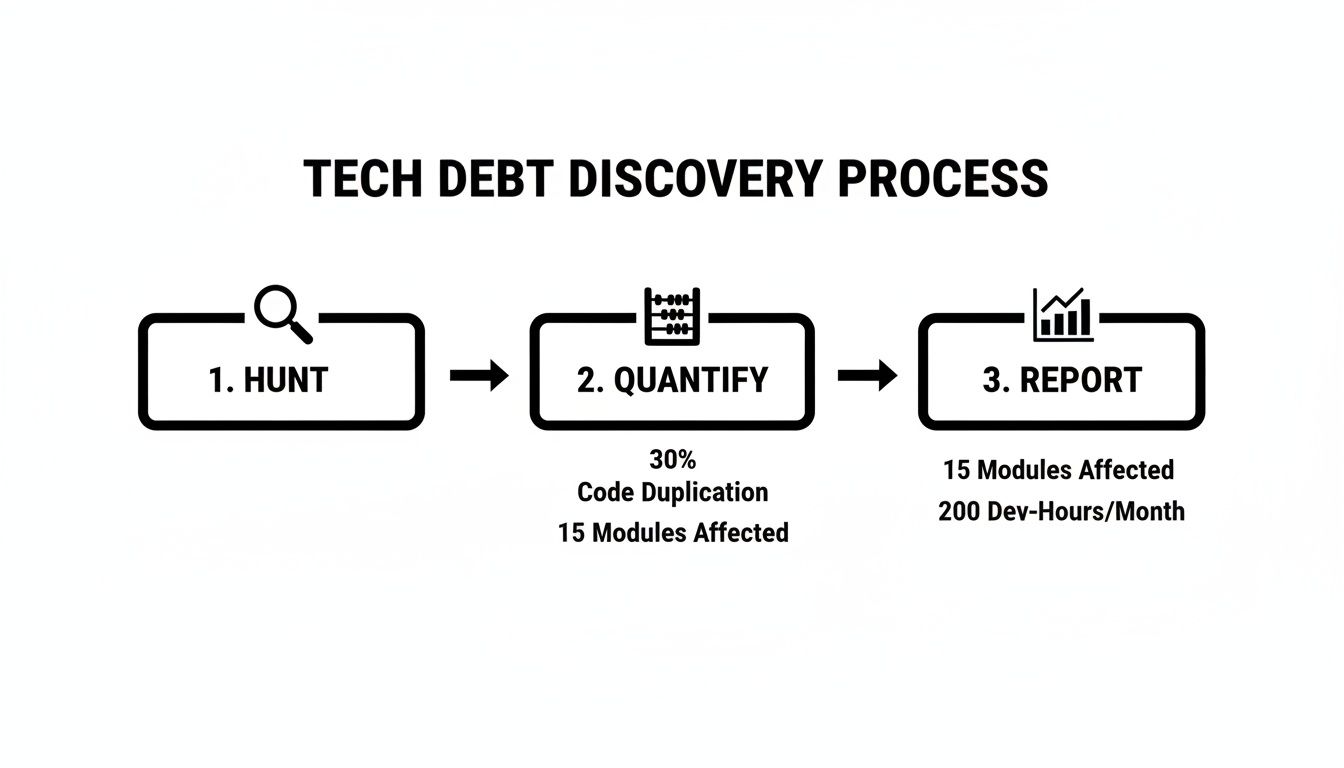
It’s a three-step dance: actively hunt for the problems, quantify their real-world impact, and then report back to get the buy-in you need to move forward.
Creating a Prioritization Matrix
The most effective tool in my playbook for this is a simple scoring matrix. Forget complicated formulas; all you need are two axes: Business Impact and Remediation Effort. This approach gives you a data-informed roadmap that helps you score quick wins, build momentum, and justify bigger projects.
-
Business Impact: This is your “how much does this actually hurt?” score. It’s all about the direct pain the issue is causing the business. A broken lead routing rule leaking 20% of MQLs into a black hole? That’s a high-impact emergency. A slightly inefficient dbt model that runs overnight and doesn’t block anyone? That’s low-impact.
-
Remediation Effort: This is the “how big of a headache is this to fix?” score. Be honest about the time and resources needed. Cleaning up a few redundant fields in Salesforce is low-effort. Decommissioning an old, tangled workflow that everyone is afraid to touch? That’s a high-effort beast.
Plotting every item from your audit on this matrix creates four clear quadrants, telling you exactly where to focus your energy.
Focusing on Quick Wins and High-Value Fixes
Your first target should always be the High Impact, Low Effort quadrant. These are your quick wins—the fixes that give you immediate, visible value without a massive project. Think about fixing a faulty data sync that’s creating daily fire drills for the sales team. Nailing these builds instant trust and credibility.
Next up, the High Impact, High Effort items. These are your big, strategic projects. They need real planning and resources but promise a massive payoff. A great example is refactoring your entire lead-to-cash data model to finally get trustworthy revenue reporting. These initiatives almost always need a solid business case and dedicated sprint capacity.
What about the Low Impact, Low Effort stuff? These are perfect for when you have a bit of downtime. Think of them as “rainy day” tasks or opportunities to apply the “Boy Scout Rule”—leave the system a little cleaner than you found it. This could be as simple as adding documentation to a confusing process or improving naming conventions.
Finally, we have the Low Impact, High Effort quadrant. My advice? Avoid these for now. These are the time-sucking black holes that offer almost no business value. Spending weeks refactoring a legacy dashboard that only two people look at is a classic example. It’s not that these issues don’t exist, but your resources are far better spent elsewhere.
This simple matrix transforms a messy, overwhelming backlog into a clear, strategic plan. It makes decisions easy. For example, fixing a broken integration causing daily support tickets (high impact) is a no-brainer compared to a non-critical refactor of a complex SQL query.
Speaking of which, if you want to turn some of those medium-effort tasks into low-effort ones, brushing up on some modern SQL query optimization techniques can work wonders. By showing you can deliver immediate value and have a clear strategy, you’ll find it’s much easier to get the green light for those bigger projects down the road.
Practical Ways to Start Paying Down Your Tech Debt

Alright, you’ve got your prioritized list of technical debt. Now it’s time to roll up your sleeves and get to work. The real trick is moving from analysis to action without derailing your team’s day-to-day. You don’t need a massive, disruptive rewrite; what you need is a playbook of practical, battle-tested strategies that fit right into your existing workflows.
One of the toughest balancing acts is fitting this cleanup work around the constant demand for new features. The best way I’ve found to handle this is to stop treating debt reduction as a separate, scary project. Instead, you have to weave it into the fabric of your team’s rhythm.
Make it a habit, not a project. By dedicating a fixed percentage of each sprint—say, 15-20%—to paying down technical debt, you turn it from a rare crisis into a consistent, manageable routine. This way, you make steady progress without putting the brakes on innovation.
Embrace the Boy Scout Rule
The simplest, most powerful habit you can build is the “Boy Scout Rule”: always leave the code (or workflow) better than you found it. It’s all about making small, continuous improvements as part of your everyday tasks.
For example, when an analyst goes into a dbt model to add a new field, they can spend an extra ten minutes adding missing tests or clearing up the documentation. If a RevOps manager is tweaking a workflow in Salesforce, they can consolidate a redundant rule they happen to spot.
These little acts of operational hygiene really compound over time. They stop new debt from piling up and gradually improve the health of your entire stack without needing a big, dedicated project.
The Strangler Fig Pattern for Big, Scary Systems
What about those larger, more intimidating problems? I’m talking about that monolithic, fragile CRM automation suite that everyone is afraid to touch. A full replacement is often way too risky to even consider.
This is where the Strangler Fig Pattern is a lifesaver. The concept, which comes from software engineering, is brilliant in its simplicity. Instead of ripping out the old system all at once, you build the new system around it, piece by piece. You slowly and carefully “strangle” the old functionality until it’s no longer needed and can be safely retired.
- The Problem: You have an ancient, all-in-one lead processing workflow in your CRM that handles enrichment, routing, and scoring. It’s brittle, poorly documented, and a nightmare to modify.
- The Fix: First, you build a new, separate lead scoring service. You then route just the final step of the old workflow to this new service. Once that’s running smoothly, you build a new routing module and reroute that piece of the logic.
- The Result: You methodically replace the legacy system with modern, modular components. This approach minimizes disruption at each step and lets you deliver value along the way, rather than holding your breath for one massive, high-stakes launch.
Here’s a look at how this and other strategies apply to common issues we see in RevOps and data stacks.
Common Technical Debt Scenarios and Solutions
| Debt Scenario | Example | Recommended Strategy |
|---|---|---|
| Outdated dbt Models | A critical dim_customers model lacks documentation, has no tests, and uses convoluted CTEs that are hard to follow. | The Boy Scout Rule: When a developer adds a new column, require them to also add tests for that column and document at least one CTE. |
| Monolithic CRM Workflow | A single, 50-step Salesforce Process Builder handles everything from lead assignment to opportunity creation. | The Strangler Fig Pattern: Carve out the “lead assignment” logic into a new, separate Flow. Once stable, do the same for the “opportunity creation” logic. |
| Redundant Data Pipelines | Three different Fivetran connectors are pulling nearly identical users data from three different sources into the data warehouse. | Decommissioning Runbook: Identify all downstream reports. Consolidate them onto a single, trusted source pipeline and then follow a clear plan to retire the other two. |
| Hardcoded “Magic Numbers” | A lead scoring model in HubSpot has a hardcoded value: IF territory = "West" AND employee_count > 500. | Refactoring: Abstract the 500 into a centrally managed variable or reference object. This makes future updates easier and more transparent. |
These patterns aren’t just theoretical; they’re practical ways to make tangible progress against what often feels like an insurmountable problem.
Mini-Runbook for Decommissioning a Pipeline
One of the most frequent debt-reduction tasks is retiring a shaky or redundant data pipeline. If you just pull the plug, you’re guaranteed to get angry Slack messages about broken dashboards. A simple runbook makes the whole process smooth and transparent.
Here’s a checklist that works:
- Map All Dependencies: First things first, figure out who and what relies on this data. Create a definitive list of every single report, dashboard, and system that will be affected.
- Communicate Early and Often: Send an initial announcement at least two weeks in advance. Be crystal clear about what is being retired, why it’s happening, and what the replacement (if there is one) will be.
- Provide a Clear Migration Path: If a new pipeline is taking over, give people clear instructions. I recommend offering office hours to help users switch their reports over to the new data source. It makes a huge difference.
- The Shutdown: On the planned day, disable the pipeline but do not delete it yet. Keep an eye out for any unexpected issues or support requests that pop up.
- Final Confirmation and Cleanup: About a week later, send a final confirmation that the pipeline is officially retired. Once you’re 100% sure it’s no longer needed, you can safely archive or delete the code and any related assets.
By tackling technical debt with a mix of small, consistent habits and structured, strategic plans, you can steadily make your RevOps and data stack more resilient and efficient. The key is to just start, stay consistent, and always keep everyone in the loop.
You’ve just climbed a mountain to fix your existing technical debt. That’s a massive win, but don’t spike the football just yet. The real challenge is making sure you don’t have to climb that same mountain again in six months.
The long-term victory comes from building a lightweight framework that stops new debt from piling up. This isn’t about adding layers of bureaucracy or red tape. It’s about instilling a few simple, sustainable habits that keep your RevOps and data stack clean from the get-go.
It’s a mindset shift. You’re moving from being a firefighter to being an architect—proactively building quality into your workflow instead of treating it like a frantic cleanup project.
Establish a Clear “Definition of Done”
Want to know the easiest way to prevent shoddy work from entering your systems? Stop it at the door. Your first line of defense is a crystal-clear Definition of Done (DoD).
Think of it as a simple, non-negotiable checklist. Before any new feature, CRM workflow, or dbt model is pushed live, it has to meet these standards. No exceptions.
A solid DoD for any RevOps or data team should always include:
- Peer Review: Someone else on the team must put a second set of eyes on the work. This simple sanity check catches an incredible number of logical flaws and mistakes before they cause real damage.
- Clear Documentation: The “why” is just as important as the “what.” A new dbt model needs clear column descriptions. A new Salesforce flow needs a short, plain-English summary of its purpose and what triggers it.
- Automated Testing: For anything critical, especially custom code or complex dbt models, it needs automated tests that pass. This is your safety net, ensuring future changes don’t unknowingly break something important.
By making these checks a mandatory part of your process, you build a powerful quality gate. It’s no longer one person’s job to “be the quality police”—it becomes a shared team commitment.
Automate Consistency with Style Guides and Linters
We’re all human. One person names a dbt model fct_mqls, and the next person calls it fact_marketing_qualified_leads. Neither is wrong, but over time, these little inconsistencies add up, creating a confusing and hard-to-navigate system.
This is the perfect job for a robot. Automated style guides and linters are tools that automatically scan your code and configurations for consistency against a set of rules you define. A SQL linter, for instance, can enforce everything from using lowercase for keywords to a specific structure for your CTEs.
An automated linter is like having a tireless, perfectly consistent code reviewer on your team. It handles all the nitpicky feedback, freeing up your human reviewers to focus on the much more important stuff, like the business logic and architecture.
This is a low-effort, high-impact way to enforce a single, predictable standard across your entire stack without relying on anyone’s memory.
Create a Tech Debt Review Board
Look, not all technical debt is bad. Sometimes, you have to take a shortcut to hit a critical deadline. That’s business. The danger isn’t in taking on the debt; it’s in forgetting you took it on.
This is where a lightweight Tech Debt Review Board comes in. Don’t let the name scare you—this isn’t some formal, slow-moving committee. It’s a recurring, 30-minute meeting with key folks from RevOps, Data, and maybe a business stakeholder.
The agenda is dead simple:
- Review New Debt: Did we intentionally cut any corners in the last sprint?
- Assess the Risk: What’s the potential blowback from this shortcut down the line?
- Make a Conscious Decision: Do we accept this for now and schedule a fix for later, or is this a “we need to fix this now” situation?
This simple ritual transforms technical debt from a dirty little secret into a strategic tool. It allows the business to make conscious, informed trade-offs between speed and stability. Every shortcut becomes a deliberate choice, not a sloppy accident. And that proactive governance is the real secret to keeping your systems clean for the long haul.
Frequently Asked Questions
Digging into your tech stack’s quirks and complexities always seems to spark more questions than answers. Let’s tackle some of the most common hurdles I see RevOps and Data leaders run into when they finally decide to get a handle on their technical debt.
How Do I Convince Leadership to Invest in This?
Ah, the million-dollar question. The trick is to stop talking like an engineer and start talking like a CFO. Forget the nitty-gritty jargon like “refactoring the opportunity sync.” Instead, you need to frame the conversation around the business metrics leadership actually loses sleep over.
Build your case around ROI. Instead of a technical deep dive, present a clear business outcome: “Fixing our opportunity sync will slash CRM errors by 75% and give the sales team back 10 hours every single week.”
Pull from the quantification methods we walked through earlier to tell a compelling story. Tie the technical debt directly to things that matter:
- Team Velocity: Show how much faster you can ship critical reports or new features.
- Data Accuracy: Connect the dots between clean data and reliable forecasting.
- Operational Risk: Explain how brittle systems are a ticking time bomb for costly outages that kill productivity.
When you walk into that meeting, bring a prioritized plan with clear deliverables and timelines. It shows you’re being strategic, not just complaining. That’s how you get the budget.
What’s a Realistic Amount of Time to Dedicate to This?
There’s no magic number here, but a good rule of thumb that I’ve seen work time and again is the 15-20% rule. Think of it as dedicating about one day a week, or one full week out of the month, to chipping away at your prioritized debt-reduction list.
This approach keeps you making steady progress without slamming the brakes on all new projects. It bakes the cleanup process right into your team’s regular rhythm, turning it into a healthy habit instead of a massive, dreaded project you only tackle once a year.
Of course, if your team is already drowning in daily fires because of shaky systems, you might need to dedicate more time upfront just to stabilize things.
Can We Ever Be Completely Free of Technical Debt?
In a word? No. And honestly, that shouldn’t even be the goal.
A system with zero technical debt is often a sign of a system with zero innovation. Sometimes, you take on debt on purpose—it’s a conscious trade-off to hit a critical market deadline or launch a new feature fast.
The goal isn’t to eliminate all debt, but to make it visible, intentional, and manageable. You want to avoid the unintentional, high-interest debt that quietly piles up from sloppy practices and eventually cripples your entire stack.
The real aim is to find a healthy balance between moving fast and maintaining a stable foundation. It’s about knowing exactly what debt you have, understanding why you have it, and having a plan to deal with it before it gets out of control.
What Are the Best Tools for Finding Technical Debt in a Data Stack?
For a modern data stack, there’s no single silver bullet. The best approach is to combine a few key tools to get a full picture of what’s happening from end to end.
For your dbt project, your toolkit should probably look something like this:
- dbt-core’s built-in docs and lineage graphs: This is your ground zero for understanding how your models are all connected.
- Third-party monitoring tools: These add another layer of insight, offering things like column-level lineage and performance monitoring to help you spot slow or inefficient models.
- Automated linters: Integrating code analysis tools into your CI/CD pipeline helps catch quality issues and enforce standards before bad code ever gets merged.
For the pipelines and integrations themselves, data observability platforms are a game-changer. They shine a light into those “black box” connectors, helping you spot API failures, slow syncs, and data quality problems before they hit your warehouse.
Feeling buried under technical debt in your CRM, dbt project, or data pipelines? At RevOps JET, we provide on-demand revenue operations engineering to help you refactor, rebuild, and remediate. We turn messy systems into maintainable, monitored, and production-grade assets so you can focus on growth, not firefighting. Learn how we can help you pay down your technical debt for a flat monthly fee.