Think of a marketing technology consultancy as a strategic partner who helps businesses untangle the complicated knot of marketing software they’ve accumulated over the years.
What Does a MarTech Consultancy Actually Do?

Let’s use an analogy: a MarTech consultant is like a general contractor for your company’s digital marketing infrastructure. You have big goals—better leads, smarter customer insights, a bigger ROI—but your tech stack feels more like a random pile of tools than a well-oiled machine. You’re probably paying for software nobody uses, your data is stuck in different systems that don’t talk to each other, and your team is wasting time wrestling with tech instead of creating great campaigns. Sound familiar?
This is where a marketing technology consultancy comes in. They don’t just show up and suggest more tools to buy. Instead, they start by understanding your business goals and then create a technology blueprint that actually helps you achieve them. Their main job is to close the gap between your marketing strategy and the tech you need to make it happen. This makes sure every piece of software has a clear purpose and plays nicely with everything else.
The need for this kind of expertise is off the charts. The marketing technology world has absolutely exploded, growing to an incredible 15,384 different solutions as of 2025. That’s a mind-boggling 10,156% increase since 2011, creating a maze of options that’s just too much for most in-house teams to handle on their own. You can dive deeper into this explosive growth over at chiefmartec.com.
A great consultant’s job is to turn a chaotic MarTech stack into a streamlined growth engine. They connect the dots between your CRM, automation platform, and analytics tools so that data flows freely, giving your team the power to make smarter, faster decisions.
This focus on strategic alignment is what really sets a consultancy apart from a simple vendor or freelancer. They are all about the outcomes, not just the technical setup. Whether that means automating tedious workflows to give your team back their time or building a reporting dashboard that everyone in the company actually trusts, their success is measured by the real-world impact on your business’s efficiency and bottom line.
Core Functions of a MarTech Consultancy
So, what does that look like in practice? A marketing technology consultancy brings value across a few key areas, all designed to make sure your tech investments are actually paying off.
Here’s a quick breakdown of what they typically handle.
Core Functions of a MarTech Consultancy
| Core Function | What It Means for Your Business |
|---|---|
| Strategic Planning & Roadmapping | They help you align tech purchases with your long-term business goals, so you stop wasting money on shiny objects. |
| Technology Audits & Optimization | They’ll find overlapping tools, uncover features you aren’t using, and help you get more value from the tech you already own. |
| System Integration | They connect separate platforms (like making Salesforce and HubSpot talk to each other) to create one reliable source of customer data. |
| Process Automation | They design and build workflows that get rid of manual work, cut down on human error, and speed up your marketing and sales funnels. |
Ultimately, their work is about making sure your technology serves your strategy—not the other way around.
What Does a MarTech Consultant Actually Do?

A great marketing technology consultancy bridges the gap between your big-picture goals and the practical steps needed to get there. While their advice is strategic, the work they deliver is concrete and designed to solve real problems and pave the way for growth. Most of their services fit into a few key categories, each one tackling a common headache for businesses trying to scale.
The MarTech Stack Audit
One of the first things a consultant will do is a deep dive into your current tech stack. Think of it as a financial audit for your software subscriptions. They’ll take a meticulous inventory of every tool you’re paying for, sniffing out expensive overlaps—like having three different tools that all handle email marketing.
They’re also looking for underused platforms. It’s surprisingly common for companies to only be using 10% of the features in a powerful tool they pay a premium for. The final deliverable isn’t just a spreadsheet; it’s a practical roadmap to help you consolidate tools, cut unnecessary costs, and simplify your team’s workflow.
Strategic Selection and Implementation
Once you know what you have, the next step is often filling in the missing pieces. A consultant can guide you through the overwhelming maze of software vendors, helping you see past the flashy sales demos to find the platform that genuinely fits your team’s process and budget.
From there, they manage the entire implementation—from the initial setup and data migration to training your team. This helps you avoid that classic pitfall where a shiny, expensive new CRM gets bought with high hopes, only to sit on a digital shelf because nobody knows how to use it or it was never set up correctly.
Instead of sales and marketing pointing fingers over lead quality, a consultant builds an automated lead scoring system right inside your CRM. This creates a single source of truth that both teams agree on, finally ending the squabbles and getting everyone focused on revenue.
System Integration and Process Automation
This is where things get really powerful. A consultant’s most valuable work often involves getting all your different systems to talk to each other. They build the digital plumbing that allows data to flow seamlessly from your website to your marketing automation tool, then into your CRM, and out to your analytics platform.
This connected setup is the foundation for game-changing automation. Check out our guide to see some powerful marketing automation integrations in action.
A MarTech consultant will design and build workflows that take tedious, manual work off your team’s plate. This could look like:
- Automated Lead Nurturing: Crafting email sequences that automatically send relevant follow-ups to new leads based on how they interact with your website.
- Data Hygiene Workflows: Setting up automated rules that clean, standardize, and enrich customer data, making your reports far more accurate.
- Seamless Sales Handoffs: Creating instant alerts and tasks for your sales team the moment a lead shows strong buying intent.
Finally, a good consultant won’t just build it all and walk away. They focus on team enablement and training. They create clear documentation and host hands-on workshops to make sure your team feels confident using the new systems. The real goal is to make your team self-sufficient so you can get the most out of your technology long after the project is over.
When Should You Call a MarTech Consultant?
It’s not always obvious when you’ve hit the ceiling with your marketing tech. The problems usually start as small, everyday annoyances. But before you know it, they’ve snowballed into massive roadblocks that are actively hurting your growth. If your team spends more time wrestling with software than actually marketing, it’s probably time to bring in a specialist.
Think about how your team gets things done. Are they constantly exporting and importing CSV files just to build a simple report? That’s not just a time-waster; it’s a glaring symptom of disconnected systems. When manual workarounds become your standard operating procedure, you’re burning through precious hours that should be spent on strategy.
Your MarTech Stack Is a Frankenstein’s Monster
One of the biggest red flags is a tech stack that’s become a jumbled, chaotic mess. This is super common. Companies add tools to fix immediate problems, but without a real strategy, things get out of control fast.
You probably need a marketing technology consultancy if any of this sounds familiar:
- Tool Overlap: You’re paying for two (or more!) platforms that do the exact same thing, like multiple email marketing services or social media schedulers.
- Shelfware: You’ve got powerful, expensive software that sits on a digital shelf collecting dust because nobody really knows how to use it.
- Data Chaos: Your customer information is scattered across a dozen different systems, making it impossible to get a single, clear picture of what a customer actually does.
A messy tech stack doesn’t just waste money on subscriptions—it creates friction. When your team can’t trust the data, they stop using it, leading to poor decisions, missed opportunities, and even customer churn. Learn more about the impacts of operational friction by reading our guide on understanding churn in SaaS.
Reporting Is a Nightmare (and Probably Wrong)
Here’s another tell-tale sign: How’s your reporting? Can you confidently answer simple questions like, “What was our marketing ROI last quarter?” or “Which channel brought in our best customers?” If getting those answers involves days of spreadsheet wizardry, you don’t have a reporting process—you have a reporting problem.
And you’re not alone. Getting all these different marketing tools to talk to each other is a huge challenge for most companies. The global MarTech market, valued at USD 558 billion in 2025, is expected to explode to nearly USD 2.86 trillion by 2034. That growth shows just how many tools are out there, and it highlights the massive complexity of making them all work together. You can find out more about these marketing technology market trends.
This is where a consultant comes in. They can build the data plumbing you’re missing, connecting all your separate systems into a single source of truth. The result? Automated, accurate dashboards that give you a real-time pulse on performance. Reporting goes from being a dreaded chore to your biggest strategic asset, helping your team make smart, fast decisions that actually move the needle.
Consultant vs. In-House vs. Agency
When your marketing engine starts to feel clunky or just plain broken, figuring out who to call for a fix can be a real headache. Should you hire a full-time employee? Bring on an agency? Or is it time to find a marketing technology consultant?
While there’s definitely some overlap between these roles, they each solve very different problems. Getting this distinction right is the first, most critical step to getting the help you actually need.
Let’s use an analogy: building a custom race car.
Your in-house team are the drivers. They’re behind the wheel every single day, running campaigns and navigating the tricky corners of your market. They know the track—your business—inside and out and are responsible for the daily execution.
A marketing agency is your specialized pit crew. You call them in to handle specific jobs you can’t manage on your own, like running paid ad campaigns, handling your social media presence, or designing slick creative assets. They execute specific plays to help you win, usually on a retainer or project basis.
A marketing technology consultant, on the other hand, is the chief engineer who actually designs and builds the car. They aren’t driving it daily or changing the tires mid-race. Their job is to architect the engine (your MarTech stack), design the chassis for peak performance (your data structure), and make sure every single component works together seamlessly. They build the high-performance machine that your team and agency get to drive.
Comparing Your Options
So, how do you choose? It all comes down to the problem you’re trying to solve. Are you short on people to run campaigns, or is the underlying system itself fundamentally flawed? That’s the million-dollar question. An agency can’t fix your broken HubSpot integration, and a consultant isn’t going to manage your weekly email newsletter.
A consultant’s job is to build a scalable system and then make themselves obsolete. They empower your in-house team with the right tools and processes, so you don’t need to rely on outside help for core operations.
This decision tree can help you see if those nagging issues—messy data, mind-numbing manual work, or expensive, unused tools—are actually signs you need a consultant.
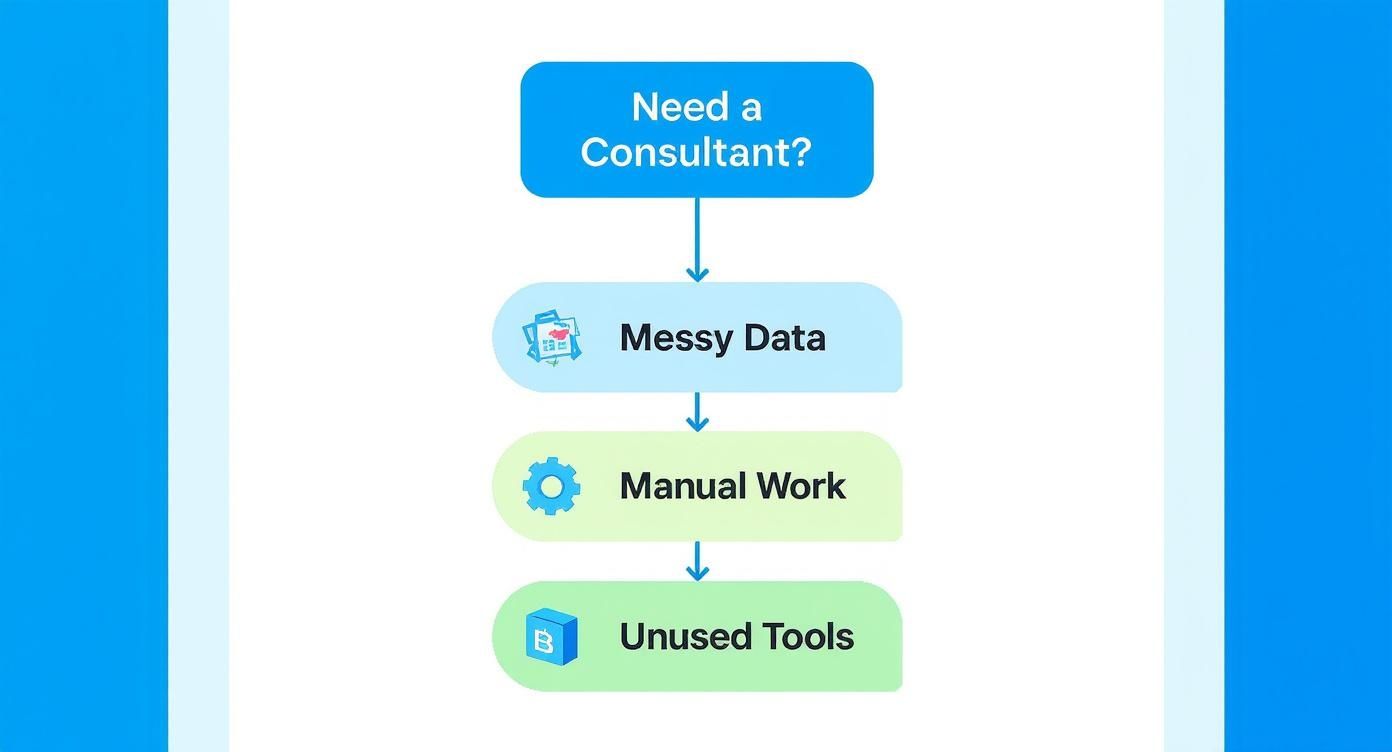
The big takeaway here is that consultants are brought in for those deep, foundational problems—the architectural issues that are holding your team and your agency back from doing their best work.
To make the choice even clearer, let’s lay out how each of these roles stack up against one another.
MarTech Consultant vs. In-House RevOps vs. Agency
Choosing the right partner often comes down to understanding their core function. This table breaks down the key differences in focus, engagement style, and the types of problems each is best equipped to solve.
| Role | Primary Focus | Engagement Model | Best For |
|---|---|---|---|
| MarTech Consultant | Strategy & Architecture. Designing systems, integrating tools, and solving complex data problems. | Project-Based. Engaged for a specific, high-impact outcome with a clear start and end. | Foundational issues like a broken tech stack, poor data quality, or a need for a strategic technology roadmap. |
| In-House RevOps | Ownership & Operations. Managing the day-to-day use of the tech stack and supporting internal teams. | Full-Time Employee. Deeply embedded in the company culture and long-term operational needs. | Ongoing management, daily support for sales and marketing, and continuous optimization of existing processes. |
| Marketing Agency | Execution & Campaigns. Running marketing activities like SEO, paid ads, or content creation. | Retainer-Based. An ongoing partnership focused on delivering specific marketing services. | Scaling campaign execution when your in-house team lacks the bandwidth or a specific channel expertise. |
Ultimately, these roles aren’t competitors; they’re complementary. A fantastic consultant builds a rock-solid system that makes your in-house team more efficient and your agency’s campaigns more profitable.
The choice really starts with an honest diagnosis of your problem. Do you need a better driver, a dedicated pit crew, or a whole new engine?
How to Choose the Right MarTech Consultancy

Choosing a marketing technology consultancy is a decision that can make or break your growth strategy. Get it right, and you’ll have a partner who turns your tangled mess of tools into a smooth-running revenue machine. Get it wrong, and you’re looking at a torched budget, a failed project, and somehow even more chaos than when you started.
So, how do you find the right fit? It takes a structured approach. You’re not just buying software or hiring a temporary contractor; you’re bringing on a strategic partner who needs to get your business, your team, and your vision inside and out. It’s time to look past the slick sales deck and dig into what really matters: their actual expertise, their working process, and their track record of delivering results.
Evaluate Their Core Expertise and Fit
The best consultants are specialists, not jacks-of-all-trades. Your very first filter should be finding firms that live and breathe your industry and your core platforms, whether that’s HubSpot or Salesforce. A consultant who’s a rockstar for e-commerce startups probably won’t get the nuances of a long, complex B2B SaaS sales cycle.
Look for proof of deep, hands-on experience. Ask for case studies that feel like they’re talking about your exact problems. A great consultancy won’t just list a tool’s features; they’ll tell you a story about how they solved a business problem just like yours for a company just like you.
Assess Their Process and Communication Style
A consultant’s methodology is every bit as important as their technical chops. You want a partner who treats the project as a collaboration, not a “black box” where you hand over the keys and hope for the best.
Ask them to walk you through how they run a project.
- Discovery: How do they dig in to understand your goals and current headaches?
- Strategy: What does their planning and roadmapping phase actually look like?
- Implementation: How do they manage the work, keep you in the loop, and handle inevitable curveballs?
- Enablement: What’s the plan to train your team so they actually use the new system?
Their process should feel organized but not rigid, with clear checkpoints built in. A truly great partner will also be an expert in B2B data enrichment, because even the best-built system is useless if it’s running on garbage data. For more on that, check out our guide here: https://revopsjet.com/blog/b2b-data-enrichment/
The most insightful question you can ask a potential partner is: “Tell me about a project that went off the rails and how you fixed it.” Their answer will reveal more about their problem-solving skills, honesty, and accountability than any polished case study ever could.
Scrutinize Their Focus on Metrics and ROI
Finally, you need a consultant who is completely obsessed with results. It’s shocking, but being good with marketing metrics is a huge challenge in the industry. Recent research found that about 60% of high-growth consultancies admit to a low capability in using marketing metrics effectively. That number jumps to a staggering 75% for lower-growth firms. You can find more details in the state of marketing consulting services report.
This is exactly why you have to be relentless about how they define and measure success. A top-tier consultancy will connect every single recommendation back to a real business outcome. Don’t be shy; ask them tough questions:
- How will you measure the ROI of this project?
- What specific KPIs are going to improve because of what you build?
- Can you show me an example of a performance dashboard you’ve created for another client?
Their answers should be confident and packed with data. If they get vague or can’t draw a straight line from their work to your bottom line, they aren’t the partner who’s going to help you grow.
Got Questions? We’ve Got Answers
Stepping into the world of marketing technology consulting can feel a bit like exploring a new city. You know where you want to go, but you’ve got questions about the best way to get there. How much will it cost? How long will it take? What if you make a wrong turn?
Let’s clear things up. Here are some straightforward answers to the questions we hear most often.
How Much Does a MarTech Consultant Cost?
This is the big one, right? The honest answer is: it depends. There’s no simple price list because every project is different. The cost really boils down to the scope of your project and the level of expertise you need.
Most engagements fall into one of two buckets:
- Hourly Rates: For quick-hit projects or a bit of on-demand advice, you’ll likely pay by the hour. Rates can range anywhere from $150 to over $400 per hour, depending on the consultant’s experience. This works well for things like ad-hoc troubleshooting or a quick gut-check on a system you’re considering.
- Project-Based Fees: This is the most common model for bigger initiatives. For example, a thorough audit of your entire tech stack might run you between $5,000 and $15,000. A full-blown CRM migration? That’s a heavier lift, often starting around $50,000 and climbing from there.
The best proposals don’t just show you a price; they connect that investment to a clear business outcome. The conversation should always be about the potential return—whether it’s saving a fortune by eliminating software you don’t need or boosting revenue with a marketing and sales machine that finally works.
How Long Does a Typical Project Take?
Like cost, the timeline is completely tied to the complexity of the job. A marketing technology consultancy can turn around strategic work pretty quickly, but the hands-on implementation is where the real time is spent.
You could have a complete strategic roadmap or a detailed tech audit in your hands in just 4 to 6 weeks. But if you’re looking to implement a brand-new marketing automation platform from scratch—including moving all your data, connecting it to other systems, and training your team—you should plan for a 3 to 6-month engagement.
For massive digital transformation projects that involve multiple departments and systems, you could be looking at a year or even longer. A great consultant will give you a transparent project plan from day one, complete with clear milestones. You’ll always know what’s happening and when it’s supposed to be done.
What Red Flags Should I Watch Out For?
Choosing the wrong partner is a mistake that can cost you time, money, and a whole lot of frustration. The good news is, the warning signs are usually there if you know what to look for.
Be wary of any consultant who starts talking about solutions before they truly understand your business goals and the problems you’re trying to solve. If they jump straight to recommending a specific tool, that’s a huge red flag. It often means they have a partnership with that vendor that benefits them more than it will ever benefit you.
Here are a few other things to keep an eye on:
- They can’t show you case studies or examples from companies like yours.
- They get fuzzy when you ask how they measure success and ROI.
- They’re hesitant to let you speak with their past or current clients.
The best consultants are partners. They’re obsessed with solving your specific problems, not just pushing a pre-packaged solution. They’ll spend the first few calls asking a ton of questions, showing they’re genuinely curious about how your business works.
At RevOps JET, we skip the vague strategies and deliver production-grade RevOps engineering on demand. If you need resilient data pipelines, scalable CRM architecture, and maintainable code without the six-figure hire, see how we can help. Learn more about our fixed-fee model.