So, what exactly is a Revenue Operations Manager?
Think of them as the strategic architect of your entire revenue engine. They’re the one person responsible for making sure your sales, marketing, and customer success teams are all rowing in the same direction to drive predictable, sustainable growth.
Essentially, they are the operational backbone of your go-to-market strategy, ensuring your processes, technology, and data all work together flawlessly across the entire customer journey.
The Conductor of Your Revenue Orchestra
Picture a world-class orchestra. You have incredible musicians in every section—strings, woodwinds, percussion—all masters of their craft. But without a conductor to bring them all together, you don’t get a beautiful symphony. You get a lot of noise.
It’s the same story for a modern B2B company. You can have incredibly talented teams, but if they’re all working in their own little worlds, you create friction, not harmony.
This is exactly where the Revenue Operations Manager comes in. They are that essential conductor, the strategic leader who aligns your go-to-market teams to create a masterpiece of predictable growth. Their main job is to knock down the walls between departments and build a single, unified revenue engine.
Moving Beyond Departmental Chaos
It wasn’t that long ago that sales, marketing, and service teams operated in their own separate universes. Marketing would generate leads and just toss them over the fence to sales. After the deal was done, customer success was left to pick up the pieces.
This old way of doing things was a recipe for disaster:
- Data Conflicts: Marketing and sales had their own metrics and tools, which always led to fights over lead quality and reports that never seemed to match up.
- Process Bottlenecks: Handoffs between teams were clunky and manual, creating delays that frustrated everyone, including potential customers.
- Poor Customer Experience: When your internal processes are a mess, the customer feels it. They get a fragmented, confusing experience that erodes trust.
A revenue operations manager tackles these problems head-on. They don’t just focus on supporting one team; they design the entire system that supports all revenue-generating activities. This big-picture view ensures that every single touchpoint, from the first ad a prospect clicks to their renewal call, is part of one cohesive strategy.
A RevOps manager’s primary responsibility is to ensure that all revenue-generating functions operate in harmony. This includes optimizing processes, unifying data systems, and enabling teams to work toward shared goals. Their work involves breaking down silos between departments, creating smoother workflows, and leveraging data to inform strategy.
The Central Nervous System of Growth
You can also think of the RevOps manager as the central nervous system of your company’s commercial side. They connect the brain (your strategy) to the limbs (sales, marketing, and customer success), making sure every move is coordinated and intentional.
By owning the tech stack, fine-tuning processes, and turning raw data into actionable insights, they transform departmental chaos into pure revenue harmony. In this guide, we’ll go way beyond a simple job description to show you why this role is no longer a “nice-to-have” but an absolute necessity for any company serious about scalable success.
Unpacking the 4 Pillars of RevOps Management
So, what does a Revenue Operations Manager actually do all day? It’s less about a simple to-do list and more about being a master juggler. Their work revolves around four distinct but deeply connected responsibilities that form the foundation of a company’s entire revenue engine.
Think of these pillars as Process Optimization, Technology Management, Data and Insights, and Strategic Enablement. A truly great RevOps manager doesn’t just work on these areas in isolation; they weave them together, making sure a change in one creates a positive ripple effect across the others. Let’s break down what each one looks like in the real world.
Process Optimization: Smoothing Out the Customer Journey
The first pillar, Process Optimization, is all about creating a frictionless path to revenue. Imagine the entire customer journey is a river. The RevOps manager is like a civil engineer, tasked with clearing out all the rocks, logjams, and debris that could slow the water down. Their goal is to ensure a smooth, powerful flow from the source all the way to the ocean.
In business terms, this means meticulously mapping every single touchpoint a customer has with your company. From the moment they click on an ad to the day they renew their contract, the RevOps manager is looking for bottlenecks and pain points to eliminate.
A classic example? The dreaded lead handoff between marketing and sales. A RevOps manager might notice that perfectly good marketing-qualified leads (MQLs) are getting ignored by the sales team. After digging in, they realize the lead scoring is vague or the data in the CRM is a mess. They don’t just point out the problem; they fix it by:
- Fine-Tuning Lead Scoring: They get marketing and sales in a room to agree on what a “hot lead” actually looks like, based on data, not just feelings.
- Automating the Handoff: They build a workflow that instantly routes a qualified lead to the right rep, armed with all the context they need to have a great conversation.
- Setting Up SLAs (Service Level Agreements): They establish clear rules, like “sales must contact a new MQL within 4 hours,” ensuring no opportunity goes cold.
This pillar is the bedrock. Without clean, efficient processes, even the fanciest tech stack and the most brilliant data scientists can’t save you. It’s all about building a predictable, repeatable system for growth.
This is where the RevOps manager steps in as the conductor, orchestrating the different go-to-market teams to play in harmony.
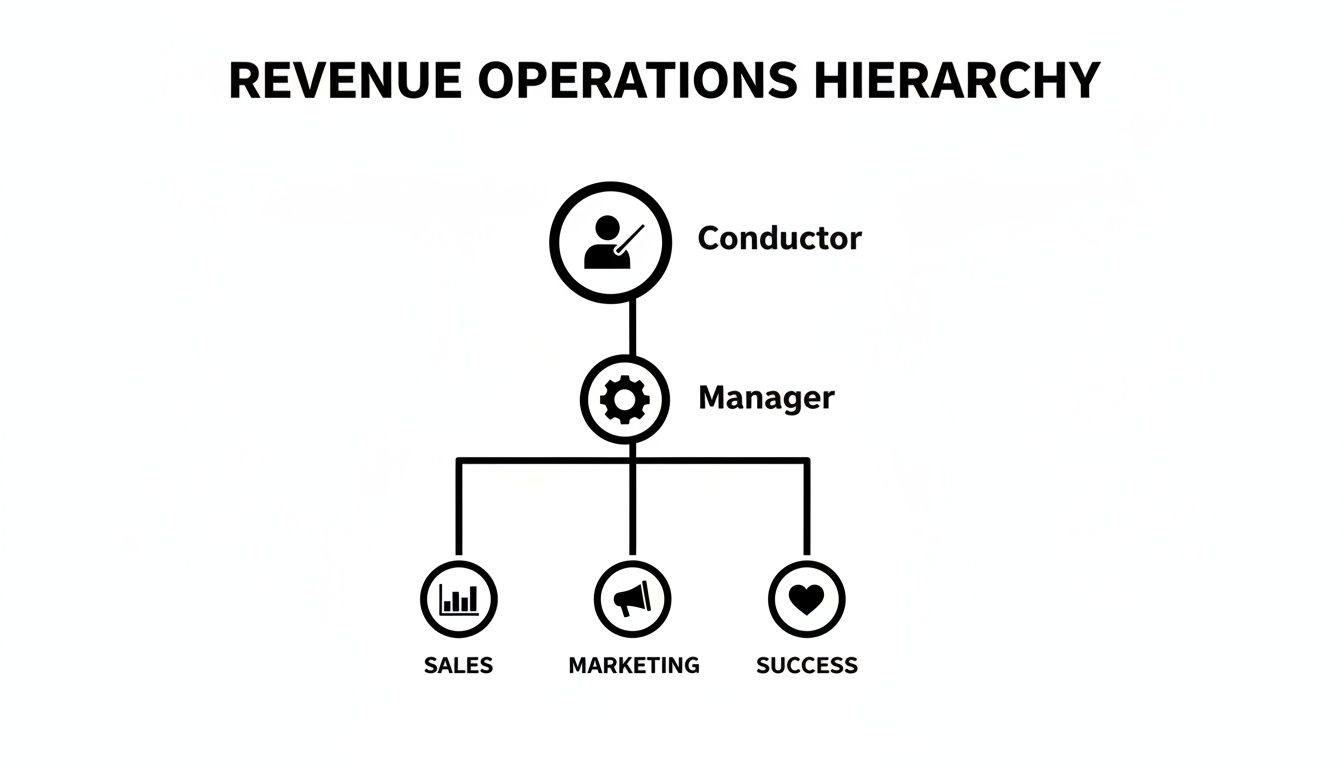
As you can see, the manager is the critical link, translating high-level strategy from leadership into coordinated, practical action for the teams on the ground.
At a glance, here’s how these four core pillars break down.
Revenue Operations Manager Key Responsibility Areas
| Pillar of Responsibility | Primary Goal | Example Activities |
|---|---|---|
| 1. Process Optimization | To create efficient, repeatable, and scalable GTM processes. | Mapping the customer journey, refining lead handoffs, establishing SLAs. |
| 2. Technology Management | To build and maintain an integrated, effective revenue tech stack. | Managing the CRM, integrating marketing/sales platforms, selecting new tools. |
| 3. Data and Insights | To provide a single source of truth and uncover actionable intelligence. | Building dashboards, analyzing funnel conversion rates, forecasting revenue. |
| 4. Strategic Enablement | To equip revenue teams with the tools and knowledge to succeed. | Creating sales playbooks, providing training on new tech, developing content. |
Each pillar builds on the others, creating a powerful system where smooth processes, smart technology, clean data, and empowered people work together to drive revenue.
Technology Management: Architecting the Revenue Stack
Next up is Technology Management. If the process is the river, then the tech stack is the series of canals, locks, and sensors that direct and measure its flow. The RevOps manager is the architect of this entire system, ensuring every single tool not only works but works together.
This role goes way beyond just being the “CRM admin.” It’s about having a bird’s-eye view of the entire ecosystem of tools that touch a customer, from marketing automation platforms like Marketo to sales engagement tools like Outreach and customer success software. The magic word here is integration.
A RevOps manager’s primary responsibility is to ensure that all revenue-generating functions operate in harmony. This includes optimising processes, unifying data systems, and enabling teams to work toward shared goals.
For instance, maybe marketing uses HubSpot and sales lives in Salesforce. The RevOps manager is the one who makes sure data flows seamlessly between them. When a lead opens a marketing email, that activity should pop up right on their contact record in Salesforce, giving the sales rep crucial intel for their next call. It’s how you avoid that classic, cringey moment where a sales rep has no idea their prospect just downloaded a whitepaper.
Data and Insights: Turning Numbers into a Narrative
The third pillar, Data and Insights, is what elevates the RevOps manager from an operator to a true strategist. This is where they put on their detective hat, combing through mountains of data to find the story hidden within the numbers. Without clean, reliable data, every business decision is just a shot in the dark.
Their main focus here is creating a single source of truth for all revenue metrics. They make sure that when marketing talks about lead volume and sales talks about pipeline, everyone is using the same definitions and pulling from the same, standardized data set. No more arguing over whose spreadsheet is right.
A perfect example is a deep dive into the sales funnel. A RevOps manager might notice that an unusual number of deals are getting stuck at the “proposal sent” stage. By digging into the data, they might uncover a surprising insight: deals that include a certain product add-on have a 25% lower close rate. Armed with that knowledge, they can work with sales enablement to build better training or with product marketing to clarify the value proposition. That’s turning data into action.
Strategic Enablement: Equipping the Teams to Win
Last but not least, we have Strategic Enablement. This is where the RevOps manager becomes a force multiplier for the entire organization. They take the optimized processes, integrated tech, and data-driven insights and use them to make every single person on the front lines better at their job.
Enablement isn’t just running a few training sessions. It’s about systematically equipping the sales, marketing, and success teams with the playbooks, content, and tools they need to execute flawlessly. For example, a RevOps manager might:
- Build an automated dashboard in the CRM that gives every sales rep a real-time, crystal-clear view of their pipeline health.
- Create a library of high-performing email templates for the marketing team to use in a new nurturing sequence.
- Develop a customer health scoring system that proactively flags at-risk accounts for the customer success team, so they can intervene before it’s too late.
By giving teams the right resources at exactly the right time, the RevOps manager bridges the gap between a brilliant strategy and brilliant execution.
The RevOps Leader’s Toolkit: Skills and Tools That Drive Success
A great Revenue Operations manager is part architect, part master builder. They need the high-level vision to design a revenue engine that can scale, but also the hands-on expertise to get in there and build it, piece by piece. Thriving in this role demands a unique combination of deep technical know-how and sharp, people-focused skills, all underpinned by a mastery of the modern tech stack.
Think of it like building a high-performance race car. You need an engineer who gets the physics of speed (the strategy) but also knows their way around a wrench to tune the engine (the technical work). A RevOps leader is both, ensuring every component works in perfect harmony to win the race.

The Hard Skills: Your Technical Foundation
To construct and maintain a sophisticated revenue machine, a RevOps manager has to have a rock-solid grasp on the tech. These are the non-negotiable hard skills that form the bedrock of their daily work.
-
CRM Administration Mastery: The CRM is the heart of the entire revenue operation. Deep expertise in platforms like Salesforce or HubSpot is absolutely essential. This goes way beyond just entering data; it’s about understanding object relationships, designing scalable data models, and building complex automation to keep the data clean and reliable.
-
Marketing Automation Proficiency: You have to be able to connect the dots between marketing activities and actual revenue. A RevOps leader needs to be comfortable inside platforms like Marketo or Pardot, building smart lead scoring models and creating workflows that hand off qualified leads to sales without a hitch.
-
Data and Analytics Expertise: RevOps is a data-driven world, period. This means getting cozy with business intelligence (BI) tools like Tableau or Looker to build dashboards that actually tell a story. Many of the best RevOps pros even know SQL, allowing them to query databases directly and uncover insights that would otherwise stay buried. This analytical horsepower is what makes tasks like building an accurate forecast possible. For a deeper dive, check out our guide on how to revenue forecast effectively.
The Soft Skills: Your Strategic Blueprint
While the tech provides the building blocks, it’s the soft skills that provide the vision. A RevOps manager can’t just be a technical wizard hiding behind a screen; they have to be a strategic leader who can get everyone rowing in the same direction. These skills are what separate a good operator from a great one.
The best qualifications for a RevOps manager aren’t just certifications or degrees—they’re a mix of technical expertise, strategic thinking, and leadership capabilities. The ability to create a unified system across disconnected teams is what sets good managers apart.
This really gets to the heart of it. The true value of a revenue operations manager is their ability to bridge the gaps between people, processes, and technology. They have to be translators, turning complex data into a compelling story that drives action.
Key Soft Skills for Driving Alignment
Here are the skills that empower a RevOps leader to turn all that technical work into real business impact:
-
Strategic Thinking: This is about seeing the entire forest, not just the trees in front of you. A strategic RevOps manager understands how a small tweak to a marketing workflow today could impact customer renewals six months from now. They connect every operational change back to the company’s biggest revenue goals.
-
Stakeholder Management: RevOps sits at the intersection of sales, marketing, and customer success. A great manager builds strong relationships with the leaders of these departments, gets to the bottom of their unique challenges, and brokers compromises that help the whole company win—not just one team.
-
Change Management: Let’s be real, people don’t always love change. Rolling out a new process or piece of tech often meets resistance. A skilled RevOps leader is a pro at managing this change by clearly communicating the “why,” providing great training, and acting as a champion for new initiatives to get everyone on board.
-
Compelling Communication: Data is useless if no one understands it. The best RevOps managers are storytellers. They can take a messy spreadsheet and turn it into a clear, actionable narrative for the executive team. They don’t just present numbers; they explain what the numbers mean and what the business should do next.
Charting Your Course: The RevOps Career Path and What You Can Earn
Becoming a revenue operations manager isn’t usually a straight shot. Think of it more like a winding road that travels through different operational pit stops, giving you a full view of the business landscape. For anyone who geeks out on systems, data, and strategy, it’s an incredibly rewarding career that puts you right at the heart of how a company grows.
Most people don’t just land a “Revenue Operations” title straight out of college. The best in the business almost always start by mastering one specific piece of the revenue puzzle. They get their hands dirty in one department, learning its unique challenges and triumphs, before they’re ready to orchestrate the entire system.
Common Starting Points on the RevOps Journey
The path usually kicks off in a role dedicated to a single go-to-market team. This is where you build your foundation—that ground-level understanding of what’s really happening on the front lines.
Here are the most common launching pads:
- Sales Operations Analyst: This is the classic entry point. You’ll live inside the CRM, become a wizard at sales reporting, and be the go-to person for reps struggling with their tech and processes.
- Marketing Operations Specialist: Here, you’ll master the marketing automation platform—think HubSpot or Marketo. Your world will revolve around lead scoring, campaign tracking, and proving marketing’s ROI.
- Customer Success Operations Analyst: This role throws you into the post-sale universe. You’ll manage the systems that track customer health, flag renewal risks, and identify upsell opportunities.
After cutting your teeth in one of these specialized roles, you might move into a senior analyst position or a broader “Business Operations” role. This is where you start connecting the dots between departments, which perfectly sets you up to step into a full-fledged revenue operations manager position.
The most effective RevOps leaders have what’s called a T-shaped skill set. They have deep, hands-on expertise in one specific area (like Sales Ops) but also a broad, strategic understanding across all the revenue teams. This lets them think big picture while still knowing how to fix the nitty-gritty problems.
Climbing the Ladder to Senior Leadership
Once you’ve got the manager role down, the path opens up to some serious leadership opportunities. Your focus starts to shift from doing the day-to-day work to setting the long-term vision and building out a team of your own.
The progression typically looks something like this:
- Revenue Operations Manager: You’re the one running the core functions—process, tech, data, and enablement.
- Senior Revenue Operations Manager: You start tackling more complex, high-stakes projects, mentoring junior team members, and having a real say in departmental strategy.
- Director of Revenue Operations: Now you’re leading the whole RevOps function. You’re managing a team of specialists and have a seat at the leadership table, likely reporting to a CRO or COO.
- VP of Revenue Operations: You’re setting the grand vision for the company’s entire revenue engine, making the big calls on tech investments and long-term operational strategy.
If you want to fast-track that journey, you have to be a lifelong learner. Diving into different revenue operations courses is a fantastic way to pick up the advanced skills you’ll need to solve bigger problems and prove you’re ready for those senior roles.
What’s the Paycheck Look Like?
RevOps salaries are a direct reflection of the role’s massive impact on the business. A talented revenue operations manager is a hot commodity, and the compensation shows it. Their work directly fuels efficiency and growth, making them indispensable.
The pay for a Revenue Operations Manager is significantly higher than for more junior roles on the team, as it should be. A typical RevOps Manager pulls in an average total compensation of $96,758. However, at many companies, more senior manager roles can push that number all the way up to $162,643.
Looking at the industry more broadly, the median on-target earnings for all RevOps professionals is around $129,000, and managers consistently earn more than that benchmark. To get a more detailed look, you can dig into the latest RevOps manager salary data on Salary.com.
How to Hire a Great Revenue Operations Manager
Trying to find the right revenue operations manager can honestly feel like you’re hunting for a unicorn. It’s a tough role to fill. You’re not just looking for a tech guru; you need a data scientist, a process architect, and a business strategist all rolled into one.
This isn’t just another operations hire. Getting this one right can completely change your company’s growth path by finally getting your entire go-to-market engine firing on all cylinders.
Spotting Top Talent Before the First Conversation
The secret is to look past the generic job descriptions and zero in on candidates who can prove they’ve actually moved the needle. A great resume won’t just list their duties; it will be packed with measurable wins.
Keep an eye out for specifics like “slashed lead response time by 30%” or “boosted forecast accuracy from 75% to 92%.” Those are the tell-tale signs of someone who drives results, not just a person who manages systems.
When you’re sorting through applications, give extra points to people who show a clear history of solving bigger and bigger problems. Did they start out as a sales ops analyst, become a CRM wizard, and then broaden their skills to cover marketing and customer success? That kind of journey shows they get the big picture and understand how every team plays a part in generating revenue.
A standout candidate will also talk about their work on cross-functional projects. They won’t just say they “managed the tech stack.” Instead, they’ll describe how they connected HubSpot and Salesforce to build a single customer view that made life easier for both marketing and sales. That’s the collaborative mindset you need in a revenue operations manager.
Asking the Right Questions in the Interview
Once you have a handful of promising candidates, the interview is where you separate the real deal from the talkers. You have to probe for both technical chops and strategic thinking. Forget the generic questions.
Try using real-world scenarios that challenge them to apply what they know.
Here are a few powerful questions to get you started:
- “Walk me through a time you had to fix a major data disagreement between sales and marketing. What was the issue, what did you do, and what happened?” A great answer here will break down their process: how they got stakeholders to agree on definitions, how they cleaned the data, and what they put in place to stop it from happening again.
- “If you started with us tomorrow, how would you go about auditing our lead-to-revenue process? What’s the very first thing you’d look at?” You’re listening for a structured, logical response. A top-tier candidate will talk about mapping the customer journey, finding conversion points, spotting bottlenecks, and digging into the data at every single stage.
- “Tell me about a complex automation you built. What problem did it solve, which tools did you use, and how did you make sure it could scale?” This one really tests their technical depth. The best answers won’t just cover the “what” but will also explain the “why”—the reasoning behind their architectural choices and how they planned for the company’s future needs.
Hiring the right RevOps leader is less about finding someone who knows every tool and more about finding someone who knows how to ask the right questions. They should be relentlessly curious about how your business works and obsessed with finding better ways to make it run.
At the end of the day, you’re not just filling a seat; you’re hiring a strategic partner. The right person will be just as comfortable diving into a messy workflow rule in your CRM as they are presenting a business case to the executive team.
As you meet different candidates, think about how their skills complement your bigger go-to-market strategy. It’s also critical to understand how this role fits into the larger departmental design, a topic we cover in our guide to building the ideal revenue operations team structure.
Common RevOps Challenges and How to Solve Them
Let’s be real: the path to a perfectly aligned revenue engine is never a smooth, straight line. It’s filled with twists, turns, and a few stubborn roadblocks. A Revenue Operations Manager is constantly staring down complex hurdles that can bring growth to a screeching halt if you’re not careful. Learning to navigate these challenges is a massive part of the job, calling for a delicate balance of diplomacy, tech-savviness, and a whole lot of strategic thinking.

The best RevOps leaders don’t just react to problems; they get ahead of them. Spotting and solving these common roadblocks before they can derail your go-to-market strategy is what separates the good from the great.
Overcoming Departmental Silos
One of the biggest, most persistent headaches is dealing with departmental silos. Sales, marketing, and customer success teams have often spent years operating in their own little worlds, each with its own goals, metrics, and ways of doing things. This creates a ton of friction and dropped batons every time a lead or customer is handed off.
To fix this, the RevOps manager has to put on their diplomat hat. It’s all about getting everyone in the same room—literally or virtually—to hash out shared goals and universal metrics. For instance, just getting sales and marketing to agree on a single, concrete definition of a “sales-qualified lead” can be a game-changing first step.
Tackling Dirty Data
Bad data is the silent killer of any revenue strategy. It’s a cancer that grows quietly. When your CRM is a mess of duplicate records, incomplete profiles, and inconsistent formatting, your forecasts are basically guesswork, and your teams are flying blind. It’s no surprise that a recent survey pointed to gaining access to quality data as a top challenge for RevOps leaders.
The solution is a two-pronged attack:
- Cleanup and Governance: You have to roll up your sleeves and clean house. This means bringing in data hygiene tools and, just as importantly, setting up strict rules for how data gets entered and maintained from now on.
- Smart Automation: The less manual entry, the better. Build workflows that automatically enrich new leads, validate information, and flag errors. This takes the pressure off your team and drastically improves data quality over time.
A Revenue Operations Manager’s effectiveness is directly tied to the quality of the data they manage. Clean, consistent data is the foundation for creating a single source of truth that aligns the entire organization.
Managing a Bloated Tech Stack
Over the years, most companies end up with a messy, bloated tech stack. A tool was bought for this, a platform for that, and before you know it, nothing talks to each other. This digital hoarding leads to wasted money, frustrated users who don’t adopt the tools, and redundant software creating more work than it saves.
The fix starts with a full-blown audit of every piece of revenue-related software. A RevOps manager has to play detective, evaluating each tool’s ROI, how well it integrates with other systems, and what the actual adoption rates look like. The goal is to trim the fat, consolidate where it makes sense, and build a streamlined ecosystem where every tool has a clear purpose. When you get this right, you free up your teams to focus on making money instead of fighting with their software.
Your Top Questions About RevOps Managers, Answered
Even after getting the big picture, a few specific questions always seem to come up. Let’s dig into some of the most common ones to give you a crystal-clear idea of what a RevOps Manager really does and why they’re so critical for any business that’s serious about growth.
What’s the Difference Between Sales Ops and RevOps?
I like to think of it this way: Sales Ops is a specialist, while RevOps is the general contractor. A Sales Operations manager lives and breathes the sales team’s world. Their entire focus is on sales forecasting, managing the CRM for the reps, and fine-tuning the sales process.
A revenue operations manager, on the other hand, zooms way out. They’re looking at the entire customer journey, from the first time someone sees an ad to the day they renew their contract. Their job is to make sure sales, marketing, and customer success are all working in harmony, with tech and processes that flow seamlessly across the whole revenue engine.
Sales Ops is all about optimizing the sales team. RevOps takes a much broader view, working to align every single revenue-generating team—sales, marketing, and customer success—into one cohesive unit.
When Is It Time to Hire Our First RevOps Manager?
The short answer? You should hire one the moment friction starts killing your momentum. If you’re constantly dealing with data conflicts between departments or your sales team is spending more time on admin work than actually selling, that’s your sign.
A few tell-tale triggers usually pop up:
- Wobbly Forecasts: Your revenue predictions feel more like a shot in the dark than a data-driven science.
- Process Breakdowns: Leads are getting lost in the shuffle as they move from marketing to sales.
- Tech Stack Chaos: None of your tools are talking to each other, which means tons of manual work and siloed information.
This pain usually hits its peak right after a company moves beyond founder-led sales and starts building out formal teams, typically somewhere around the 50-100 employee mark.
What’s the Average Salary for This Role?
Given how strategic this position is, the pay for a RevOps Manager is quite competitive. The exact number can swing based on location, company size, and the candidate’s experience, but you can generally expect the median total pay in the US to be somewhere between $117,000 and $128,000 a year.
Keep in mind, that number can jump significantly higher in major tech hubs like San Francisco or New York. The demand is fierce for sharp leaders who can build a predictable, scalable revenue machine.
When your RevOps problems get too technical for your team to handle, you don’t need another consultant—you need actual engineers. RevOps JET gives you on-demand, production-grade engineering to build the solid data pipelines, CRM architecture, and custom integrations your business needs to scale. Stop letting technical debt hold you back. See how we can help.