Revenue Operations brings sales, marketing, customer success, and finance together under one umbrella. Think of it like an orchestra conductor, smoothing handoffs and sharpening forecasts so every team moves in harmony.
How Revenue Operations Organizes Teams

Start by charting out each core function and how they feed into revenue goals. Everyone follows the same playbook, which breaks down silos and boosts predictability.
- Sales Operations: Owns processes, pipeline hygiene, and forecasting
- Marketing Operations: Manages lead gen, scoring, and campaign tracking
- Customer Success Operations: Focuses on retention metrics and renewals
- Revenue Enablement: Develops training, playbooks, and seller support
- Technical Engineering: Builds data pipelines, integrations, and dashboards
Together, these teams perform like strings, brass, and percussion sections all reading from the same score.
Orchestra Metaphor For Alignment
Picture each RevOps role as a musician. They specialize in different parts, yet rely on precise cues from the conductor. Miss one beat, and the whole performance stumbles.
A strong RevOps structure is like sheet music—it keeps every note aligned for a flawless show.
With that clarity, forecasting accuracy can jump by 20%, and handoff errors become a thing of the past.
Preview Of This Guide
We’ll walk through three popular models—centralized, pod, and hybrid—using real-world examples. You’ll see:
- How each model scales by scope and complexity
- Which roles you need and where skill gaps tend to appear
- Headcount guidance to hit peak efficiency
- Tips for integrating tech without breaking workflows
If you’re hungry for deeper training, check out Revenue Operations Courses.
Along the way, you’ll discover how a partner like RevOps JET can step in to build data pipelines, run reverse ETL, or set up bi-directional syncs whenever you hit a technical snag.
Why Structure Matters
A clear RevOps blueprint cuts overlap and speeds decision-making. When processes are well-defined, teams spend less time firefighting and more time closing deals.
- Quicker reaction to market shifts
- Better visibility across departments
- Forecasts that require fewer revisions (and headaches)
For instance, consolidating data sources often slashes reporting time by 30%.
Next up, we’ll dive into each model—starting with a centralized team—so you can choose the structure that fits your growth stage.
Exploring Common RevOps Team Models
A well-defined RevOps structure acts like a GPS for your growth journey. By picturing different setups, you can align your team model with your company’s stage and culture.
Centralized Model
Think of a centralized team as a symphony orchestra, all playing from the same sheet music under one conductor. Every process—campaign execution, pipeline hygiene, forecasting—follows a uniform playbook.
For instance, a B2B SaaS firm with $30M ARR assembled a five-person centralized RevOps squad reporting to the VP of RevOps. They handled everything from demand generation to revenue analysis in a single hub.
Key perks:
- Streamlined decision making thanks to one clear line of sight
- Consistent metrics and handoffs across all functions
Keep in mind, this setup can feel rigid when product lines demand bespoke strategies.
Pod Model
Pods resemble sports teams—small, cross-functional units that huddle around specific plays. Each pod blends marketing, sales, customer success, and analytics pros focused on a particular segment.
A mid-market company spun up three pods targeting enterprise, SMB, and channel partners. These mini-teams owned end-to-end metrics and pivoted quickly on niche campaigns.
Pod advantages:
- Hyper-focused attention on each segment drives better conversion
- Rapid experimentation lets teams react instantly to market feedback
- Heightened ownership fuels accountability
Yet pods can lead to duplicated roles and occasional misalignment between squads.
Hybrid Model
Picture a network of specialist hubs linked by shared resources. The hybrid model weaves together centralized expertise and embedded analysts.
A $100M ARR SaaS leader kept a core team of data engineers and enablement leads, while placing two analysts in every product line. This structure offered both the rigor of a central team and the responsiveness of pods.
Hybrid highlights:
- Balanced oversight with local agility
- Efficient resource sharing between central and embedded experts
Cross-Functional Alignment Drives Measurable Impact
Centralized metrics and joint processes can lift revenue by double digits.
Comparison Of RevOps Team Models
Below is a side-by-side look at centralized, pod, and hybrid structures—when each shines and the top benefits they bring.
| Model | Structure Highlights | Ideal Company Stage | Key Benefits |
|---|---|---|---|
| Centralized | One core team orchestrates all revenue functions | Early to mid-market | Standardized processes, clear oversight |
| Pod | Cross-functional mini-teams focused on segments or regions | High-growth startups to scale-ups | Fast iteration, segment-tailored support |
| Hybrid | Core specialists plus embedded experts in each unit | Scaling mid-market to enterprise | Flexibility, resource sharing |
Whether you’re just launching or scaling for enterprise, this table helps you weigh the models side by side.
Choosing Your Model
To zero in on the right RevOps structure, reflect on:
- Company Stage: Centralized works well for teams under 10; pods shine when you need segment-level focus.
- Decision Speed: Pods accelerate tactical moves; centralized ensures stable governance.
- Tech Complexity: A hybrid approach embeds specialists for intricate stacks.
- Resource Constraints: Centralized minimizes role overlap and headcount bloat.
- Cultural Fit: Pods thrive in collaborative, entrepreneurial environments.
Run a short pilot—document outcomes, gather team feedback, then refine before a full rollout.
The diagram above breaks down each model’s workflow. You’ll notice how the centralized team maintains a single data stream, pods branch into focused nodes, and the hybrid merges both patterns seamlessly.
Read the full research about unified RevOps metrics and processes.
Clarifying RevOps Roles And Seniority
Think of your RevOps team as an orchestra: when every musician knows their part, the performance flows seamlessly. Clear role definitions remove bottlenecks and stop people from stepping on each other’s toes.
At the top, the VP of RevOps (or Chief Revenue Officer) conducts the ensemble—setting strategy, aligning sales, marketing, and customer success, and keeping everyone focused on common goals. This leader usually oversees 3–5 core positions to make sure each function plays in harmony.
According to recent benchmarks, companies with dedicated RevOps teams report a 21% increase in sales productivity. For a deep dive into those numbers, check out RevOps Statistics at 1up.ai.
Key RevOps Leadership Roles
The VP of RevOps crafts the vision and governance framework while tracking metrics like forecast accuracy and pipeline velocity. They need strategic foresight, sharp communication skills, and a deep grasp of go-to-market processes.
Reporting into the VP, the RevOps Manager acts as the project conductor—coordinating cross-functional initiatives, enforcing standardized workflows, and driving continuous improvement.
- RevOps Manager: Oversees projects, streamlines processes, and reduces interdepartmental friction.
- Data Analyst: Mines revenue data, builds dashboards, and uncovers trends for better forecasting.
- Enablement Lead: Designs training programs and playbooks to accelerate seller performance.
- Technical Specialist: Engineers data pipelines, integrations, and automations to keep systems in sync.
Essential Functional Roles
A Data Analyst connects the dots between CRM, marketing automation, and financial systems. When opportunity velocity dips, they pinpoint the cause and recommend targeted campaign tweaks.
Meanwhile, the Enablement Lead crafts workshops and playbooks that can shrink ramp time by up to 30%, boosting seller confidence and win rates.
Behind the scenes, technical specialists build the plumbing—reverse ETL jobs, bi-directional syncs, and observability tools—to deliver real-time insights across platforms.
“Clarity on roles cut time-to-close by 15% in our mid-market pilot,” says a RevOps director.
Mid-Market Company Example
Imagine a $50M ARR SaaS company that hit a crossroads. They:
- Documented each role’s responsibilities in a shared handbook.
- Aligned reporting lines under a newly hired VP of RevOps.
- Launched weekly syncs to catch issues before they snowball.
- Brought on a technical specialist to automate lead routing.
This simple playbook boosted accountability and dissolved friction almost overnight. Below, the infographic visualizes how centralized, pod, and hybrid models tie these roles together.
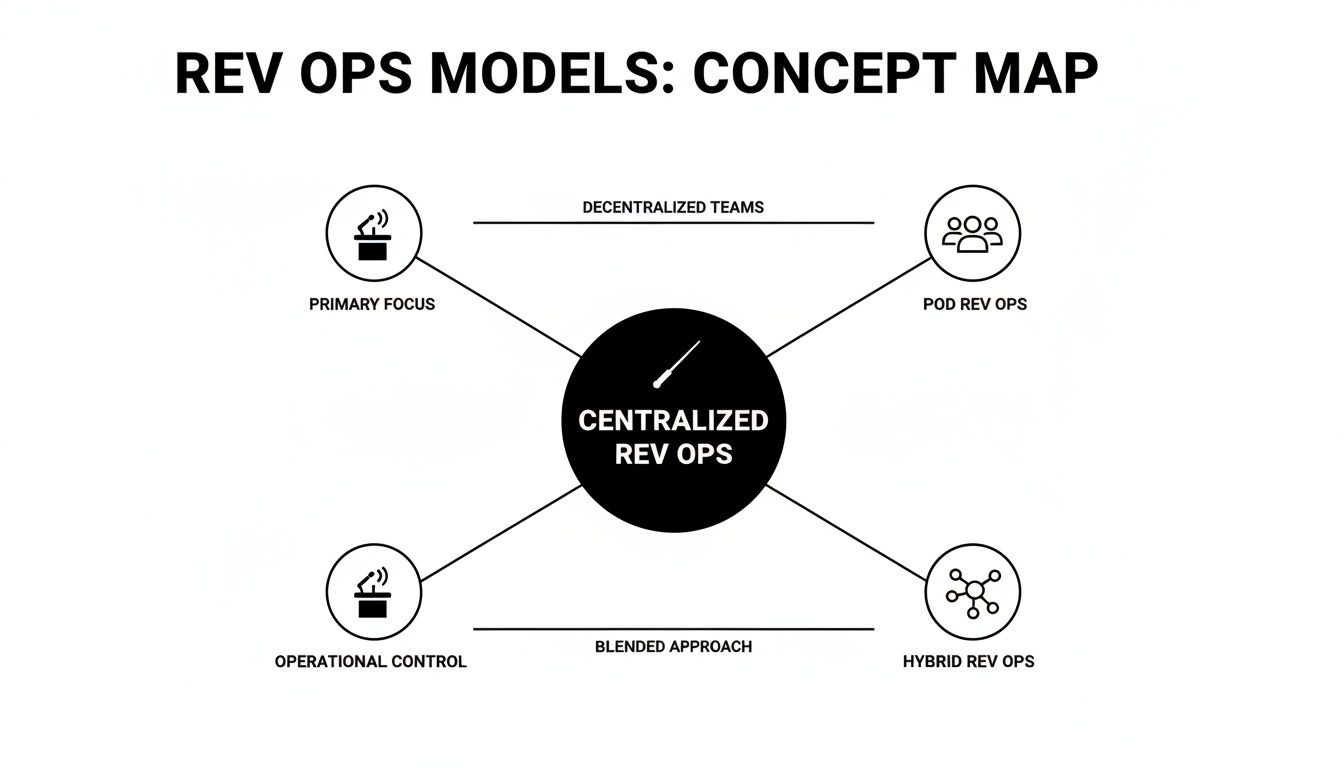
This concept map shows how you can scale from a single “conductor” approach to small, focused squads—without losing the shared processes that keep everyone in tune.
Mapping Roles To Your Business Needs
Choosing which RevOps roles to hire first is like prioritizing instruments in an orchestra—you start with the ones that fill the biggest gaps. Use this framework:
- Audit your tools, processes, and data to uncover revenue engine gaps.
- Score each gap by its impact on deal velocity and forecast accuracy.
- Hire roles that address the highest-impact gaps first.
At an early-stage startup, a RevOps Generalist can cover multiple functions. As you grow to mid-market, dedicated analysts and enablement leads become essential. Partnering with a specialist like RevOps JET instantly fills technical gaps—from production-grade code and reverse ETL to bi-directional syncs and observability—so your team can stay focused on strategy.
Role Development And Career Paths
Clear career paths help keep your top performers engaged. Consider these ladders:
- Associate Data Analyst → Senior Data Analyst (2–3 years, with growing ownership of analytics and dashboard engineering)
- Enablement Specialist → Enablement Manager (deepening expertise in course design, coaching, and playbook development)
- Technical Specialist → RevOps Engineer/Tech Lead (owning complex integrations and platform architecture)
As a rule of thumb, aim for one RevOps professional per 10–15 sellers, with managers overseeing 3–4 contributors. This balance ensures your team stays agile while delivering maximum impact.
Planning RevOps Headcount And Ratios
Think of RevOps headcount as adding lanes to a busy highway. Each new role smooths traffic, cutting down bottlenecks in forecasting and enablement.
In the early days (under $10M ARR), most startups get by with a single RevOps generalist handling analytics, process design, and basic enablement. As revenue climbs, you gain room to introduce specialists who dig deeper into data and keep operations humming.
Headcount Growth Feels Like A Highway
- Start with one RevOps generalist wearing all the hats
- Bring on a data analyst to sharpen forecasting
- Add an enablement lead to accelerate seller ramp time
- Scale out to a full team of 15–20 specialists at enterprise level
One key insight: early-stage companies (under $10M ARR) typically have just one full-time RevOps hire. By $50M ARR, introducing a data analyst can boost forecast accuracy by 20%, streamlining decision-making. At $500M+ ARR, enterprises often expand to 15–20 RevOps pros and see around 15% higher quota attainment. Read more about these findings on MarketerHire.
This chart illustrates how teams evolve: one generalist at the start, a compact mid-market crew of 3–5, and a robust 15–20 member squad in large organizations.
RevOps Headcount By ARR
Below is a quick glance at typical team sizes, core roles, and the forecast accuracy gains you can expect as ARR grows.
| Company ARR | Typical Team Size | Key Roles | Forecast Accuracy Impact |
|---|---|---|---|
| Under $10M | 1 | Generalist (RevOps) | Base level |
| $50M | 3–5 | Data Analyst, Manager, Enablement Lead | +20% |
| $500M+ | 15–20 | Specialized roles across functions | +15% |
By tracking headcount against ARR milestones, you can predict when to hire next and how each role moves the needle on your forecast.
Role Prioritization At Each Stage
- Hire a RevOps Generalist to cover analytics, processes, and enablement in the early phase
- Add a Data Analyst when forecasting accuracy dips
- Bring in an Enablement Lead to reduce ramp time for new sellers
- Scale to a full specialist roster for complex enterprise needs
1 RevOps member per 10 sellers is a solid benchmark to maintain smooth operations.
Consider your budget runway and seller count before hiring. This way, every hire lines up directly with revenue objectives.
Building A Scalable RevOps Highway
- Identify current bottlenecks and map them to missing roles
- Align hires with forecast accuracy, ramp time, and quota attainment goals
- Revisit your team-to-seller ratio each quarter as ARR climbs
Working with a technical partner like RevOps JET can offload pipeline coding, reverse ETL setups, and bi-directional syncs. They’ll document everything in Git, so your core team focuses on strategy instead of system plumbing.
A partner often saves 300+ engineering hours per year compared to hiring full-time specialists.
Guidance On Team Ratios
Aim for 1 RevOps professional per 10–15 sellers in early to mid-market stages. As complexity grows, shift toward 1:8 or even 1:5 to cover deeper analytics and enablement needs.
- Track seller performance to justify new hires
- Use ramp metrics to spot enablement gaps
- Monitor forecast variance—if it exceeds 10%, it’s time for another analyst or systems expert
Regular audits of processes and data flow keep your “lanes” clear as more traffic rolls in.
Key Takeaways For Staffing
- Start lean, then expand roles at key ARR milestones
- Let data guide your headcount ratios
- Partner with technical experts to bridge engineering gaps
- Tie every hire to forecast accuracy and ramp metrics
This framework ensures your RevOps engine scales in step with revenue growth—and never gets stuck in traffic.
Managing Technical Responsibilities And Tool Integration

Integrations and data pipelines are the arteries and veins that keep your operations team alive. Picture a railway network: each station is a system, and each track is an API call or sync. When a reverse ETL job derails, you end up with reporting delays and outdated insights.
One mid-market SaaS company discovered their KPIs lagged by 24 hours because a bi-directional sync was misconfigured.
- Data pipelines bridge your CRM, analytics warehouse, and marketing tools.
- Bi-directional syncs ensure information flows smoothly in both directions.
- Reverse ETL pumps analytics insights back into operational systems.
Designing Fail-Safe Data Pipelines
Think of pipeline design like plotting a train route: you need clear schematics before laying tracks. Include these safety features:
- Define exact data schemas upfront to prevent mismatches.
- Implement logging and real-time alerts so you catch failures immediately.
- Use idempotent operations to allow safe retries without duplicate records.
Auto-retries and alerts guard against API rate-limit hiccups or service outages.
Avoiding Common Sync Pitfalls
Misaligned field mappings can create endless loops—like trains circling a broken switch. One team found duplicated lead records overwhelming their CRM, leading to a 15% drop in response rate.
You can explore more patterns in our guide on data integration best practices.
Visualizing Metrics With Dashboards
Dashboards turn raw numbers into clear signals. Layer charts, set threshold alerts, and version-control your metric definitions to avoid drift. One retailer saved 200+ hours each quarter by standardizing their dashboard setup.
Still, schema drift can shut down your forecasts. When a revenue dashboard went dark for two days, a specialist refactored the ETL jobs and slashed recovery time by 80%.
Partnering with RevOps JET fills technical gaps without extra headcount. Their team delivers production-grade code, reverse ETL, and sturdy bi-directional syncs on a fixed monthly retainer. Weekly sprints and transparent Git documentation keep everyone in sync.
Clients typically reclaim 300 engineering hours per year compared to an in-house build.
“The right integration pattern shifted our forecast accuracy from 70% to 95%,” says a RevOps leader.
Selecting The Right Integration Tools
Picking your integration tool is like choosing the right engine for your train. You’ll want to weigh data volume, API complexity, and your team’s skill set:
| Tool Type | Best For | Trade-Off |
|---|---|---|
| Lightweight ETL | Simple one-way integrations | Limited scalability and features |
| Enterprise ETL | High-volume, multi-tenant | Higher cost and more complex |
| Custom Code | Unique business logic | Requires developer resources |
Review existing technical debt before adding platforms. Solid documentation and runbooks will help your team get onboarded in days, not weeks.
Final Tool Integration Tips
- Conduct a pilot with real data slices to validate flow reliability.
- Schedule quarterly schema audits to catch early drift.
- Standardize naming conventions for easier maintenance.
When integrations and technical ownership align, your RevOps engine hums like a well-timed train network. Invest in training or lean on expert partners to keep your operations on track.
Choosing The Right RevOps Team Structure
Finding the best RevOps setup doesn’t have to feel overwhelming. With a clear framework, you can match your team model to company size, culture, tech stack and growth goals. We’ll walk through a decision matrix, leadership stories and a hands-on pilot plan so you pick the right structure—centralized, pods or hybrid.
Decision Matrix Workshop
Bring together leaders from sales, marketing, customer success and finance in a short, focused session. Lay out a matrix where each factor—like tech complexity or strategic growth—is scored from 1 to 5. Totals point you to the structure that most closely fits your needs.
- Identify high-impact criteria and assign weights
- Walk through each factor with a concrete example
- Record scores on a shared board for full visibility
- Use color coding to spotlight your top options
Once the matrix is complete, you’ll see whether a centralized, pod-based or hybrid approach makes the most sense. Sometimes culture or rapid expansion will push you toward pods. Either way, you’ll base your choice on data, not guesses.
Leadership Anecdote
A CEO at a fast-growing SaaS company started with a centralized RevOps team—5 analysts under a VP. After launching a major feature, feedback loops slowed to a crawl and insights stayed trapped in silos.
They pivoted to cross-functional pods, grouping marketing, sales and support experts into two-week sprints. Within 30 days, issue resolution sped up and customer feedback jumped 30%.
“Pods gave us agility to fix bugs in hours, not weeks.”
– CEO, Acme SaaS
That real-world example brings the matrix to life. It shows how your risk tolerance, pace and resources align with each model.
Pilot Plan Template
Run a low-risk, one-month pilot in a single segment, product line or region. Define clear success metrics—like lead response time, forecast variance or deal cycle length—and set up a small steering committee for weekly check-ins.
- Select segment experts to staff your pilot
- Configure processes and tools for your chosen model
- Hold daily stand-ups to surface blockers immediately
- Track feedback and compare against your metrics
After four weeks, review what worked, document lessons learned and tweak your approach. This experiment turns theory into actionable insights.
Learn how to reduce technical debt in your RevOps stack by reading our detailed guide on reducing technical debt.
Choosing the right RevOps structure can reshape collaboration and speed up revenue growth. With a matrix, leadership buy-in and a pilot plan, you’re making a smart, low-risk move.
| Phase | Action | Outcome |
|---|---|---|
| Matrix | Score criteria and reveal priorities | Clarity on optimal model |
| Workshop | Facilitate scoring and discussion | Shared leadership alignment |
| Pilot | Run low-risk trial in one segment | Data-driven final decision |
Best Practices
- Keep your criteria focused on outcomes and impact
- Involve cross-department leaders at every stage
- Document insights and iterate before scaling
Continuous review—using real metrics and team feedback—keeps your RevOps structure in tune with changing needs. Start small, move fast, measure results and refine until you hit your goals.
Frequently Asked Questions
What’s The Fastest Way To Launch A Centralized RevOps Team?
Kick things off by mapping your sales, marketing, and customer success workflows. Within week one, name a RevOps lead. By week two, roll out a straightforward playbook to smooth handoffs.
- Define Key Processes and assign clear owners
- Establish an SLA for handoff timing
- Use a Shared Dashboard for early visibility
Assess Data Analyst Needs
How Many Data Analysts Does A Mid-Market RevOps Team Need?
If you’re hitting $50M ARR, start with one dedicated data analyst. That alone can boost forecast accuracy by 20%.
Mid-market firms often start with 1 analyst per 10–15 sellers.
When forecast variance stays above 10%, consider a second hire. Align each analyst with specific growth segments to keep them focused and avoid overlap.
- Scale up analysts when forecast variance or deal cycles stall
- Embed them in teams or centralize based on your chosen model
Scaling From Pod To Hybrid
-
Can I Evolve From A Pod Model To A Hybrid Structure As ARR Grows?
Absolutely. Pilot one segment, score results with a simple decision matrix, then expand where you see the best metrics. -
Which Integrations Should I Prioritize First?
Start with CRM-to-warehouse pipelines. Next, layer in reverse ETL. Finally, enable bi-directional syncs for real-time data flow.
Ready to offload RevOps work? Partner with RevOps JET for production-grade engineering, saving 300+ engineering hours per year. Learn more at the RevOps JET website